ROGUE NICOTINE POUCHES INGREDIENTS: WHAT'S ACTUALLY IN THE CAN
Roon Team
Rogue Nicotine Pouches Ingredients: What's Actually in the Can
You popped a Rogue pouch between your lip and gum. The nicotine hit landed. The mint flavor checked out. But do you actually know the rogue nicotine pouches ingredients you just put in your mouth?
Understanding rogue nicotine pouches ingredients matters more than most users realize. These pouches sit against your oral mucosa for 20 to 40 minutes at a time, and everything inside them gets absorbed directly into your bloodstream. That's worth a closer look.
This article breaks down every component in the rogue nicotine pouches ingredients list, explains what each one does, and flags what the science says about safety.
Key Takeaways
- Rogue pouches contain nicotine polacrilex, a pharmaceutical-grade nicotine compound bound to a resin for controlled release.
- Plant-based fibers and food-grade additives make up the rest of the rogue nicotine pouches ingredients: cellulose, gum arabic, sweeteners, and pH adjusters.
- Nicotine is the only pharmacologically active ingredient, and it carries real dependence risk at any dose.
- Nicotine-free alternatives exist that deliver focus and energy through different mechanisms entirely.
The Active Ingredient in Rogue Nicotine Pouches Ingredients: Nicotine Polacrilex
The star of every Rogue pouch is nicotine polacrilex, a nicotine-resin complex originally developed for smoking cessation products like Nicorette gum. <cite index="3-0">Rogue products contain the active ingredient nicotine polacrilex and other inactive food grade ingredients added for flavor and texture.</cite>
This isn't raw nicotine extract. <cite index="2-6,2-7">Nicotine polacrilex is a nicotine-resin complex. You can think of it as a carrier that holds onto the nicotine.</cite> The resin binds to nicotine molecules and releases them gradually when the pouch contacts saliva. That slow release is what separates a controlled oral dose from the sharp spike you get from a cigarette drag.
Rogue offers two strengths: 3mg and 6mg per pouch. <cite index="6-0">Each is available in 3mg and 6mg of nicotine per pouch.</cite> For context, a single cigarette delivers roughly 1 to 2mg of absorbed nicotine, so even the "lighter" Rogue option puts you in a comparable range, and the 6mg pouch delivers a substantially higher dose per session.
Why the Delivery Method Matters
Nicotine absorbed through the oral mucosa bypasses the lungs entirely. <cite index="1-0">The use of the polymer as a delivery system maximizes the amount of nicotine released and absorbed by the oral mucosa.</cite> According to Wikipedia's entry on nicotine polacrilex, 80 to 90 percent of the nicotine released from the resin complex gets absorbed through the mouth.
That's efficient. It also means tolerance and dependence can build quickly. <cite index="5-0">While pouches eliminate combustion-related toxins, they deliver nicotine doses that can create dependence comparable to cigarettes.</cite>
Rogue Nicotine Pouches Ingredients: The Full Breakdown
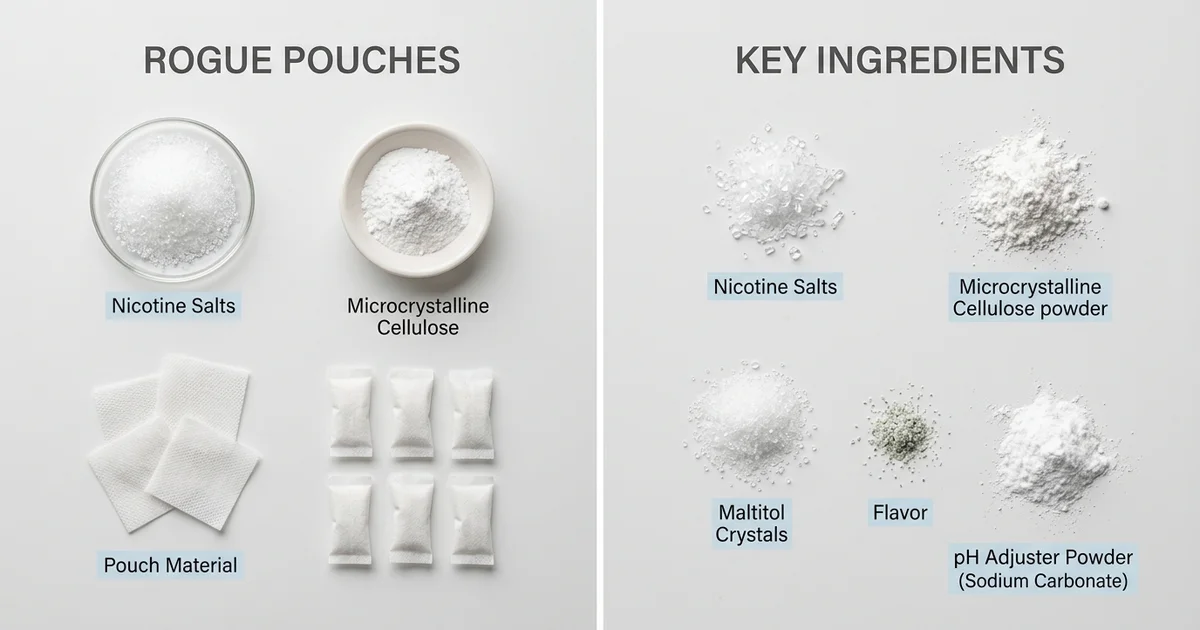
Beyond nicotine polacrilex, the rogue nicotine pouches ingredients list contains a handful of inactive compounds. <cite index="4-0">Rogue nicotine pouches are made with a variety of food-grade ingredients, including plant-based fibers, flavorings, artificial sweeteners, stabilizers, and pH balancers.</cite> Here's what each category includes and why it's there.
Plant-Based Fibers
Among the rogue nicotine pouches ingredients, the pouch material and its filler come from two cellulose compounds:
- Hydroxypropyl cellulose (HPC): A plant-derived polymer that gives the pouch structural integrity. It keeps the pouch from falling apart in your mouth.
- Microcrystalline cellulose: A refined wood pulp product used as a bulking agent. It's the same ingredient found in many pharmaceutical tablets.
<cite index="0-0,0-1">Hydroxypropyl cellulose and microcrystalline cellulose are plant-derived fibers that enhance the pouch's structural consistency, ensuring it remains intact during use.</cite>
Neither of these fibers is absorbed by the body. They pass through without any pharmacological effect.
Sweetener: Acesulfame K
Acesulfame K is one of the rogue nicotine pouches ingredients responsible for taste. <cite index="3-1">Rogue has no sugar and is sweetened by Acesulfame K which is commonly used in soft drinks, juices, and other foods.</cite>
Acesulfame potassium (Ace-K) is a zero-calorie artificial sweetener about 200 times sweeter than sugar. The FDA considers it safe for general use, and <cite index="8-1">before approving these sweeteners, the FDA reviewed numerous safety studies that were conducted on each sweetener to identify possible health harms.</cite>
That said, the picture isn't completely clean. <cite index="7-0">A 2024 review also suggests a link between acesulfame potassium consumption and higher central precocious puberty risk in females.</cite> A 2025 review published in ScienceDirect also noted that preclinical models have reported alterations in gut microbiota composition and lipid metabolism at high doses.
The amounts in a single pouch are tiny. But if you're using 10 to 15 pouches a day (common among heavy users), the cumulative exposure from this and other rogue nicotine pouches ingredients adds up.
Stabilizer: Gum Arabic
Gum arabic is a natural plant-derived gum harvested from acacia trees. Within the rogue nicotine pouches ingredients, it acts as a binding agent that holds the dry components together and maintains a consistent texture.
It's one of the oldest food additives in existence, widely used in everything from soft drinks to candy. No real safety concerns here.
pH Balancers: Sodium Carbonate and Sodium Bicarbonate
These two compounds are the silent workhorses among rogue nicotine pouches ingredients. <cite index="9-0">pH adjusters such as sodium carbonate, sometimes in combination with sodium bicarbonate, are used to adjust the pH of the pouches to reach absorption levels within the desired range.</cite>
Here's why that matters: nicotine absorbs best in an alkaline environment. By raising the pH inside the pouch, sodium carbonate and sodium bicarbonate convert more nicotine into its "freebase" form, which crosses the oral mucosa more efficiently.
Sodium bicarbonate is just baking soda. Sodium carbonate (washing soda) is a stronger base. <cite index="10-0">Most pouch brands use sodium carbonate, also known as washing soda, to push pH upward. With a pH around 11, it's a powerful base often found in industrial cleaners.</cite> According to Lone Pouches, this can sometimes cause the stinging or burning sensation users report.
Flavorings
Rogue doesn't disclose its exact flavoring compounds, which is standard across the nicotine pouch industry. Among the rogue nicotine pouches ingredients, flavorings remain the most opaque category. What we know is that the brand offers a wide range of options. <cite index="7-1">With options ranging from classic mint and tabac, to fruit-forward favorites like mango and berry, Rogue has one of the largest flavor ranges.</cite>
Current Rogue flavors include Peppermint, Wintergreen, Spearmint, Mango, Citrus, Berry, Honey Lemon, Apple, Tabac, and an unflavored Original option.
Full Rogue Nicotine Pouches Ingredients at a Glance
| Ingredient | Category | Role |
|---|---|---|
| Nicotine polacrilex | Active ingredient | Delivers nicotine via controlled release |
| Hydroxypropyl cellulose | Plant fiber | Structural integrity of the pouch |
| Microcrystalline cellulose | Plant fiber | Bulking agent and filler |
| Gum arabic | Stabilizer | Binds ingredients together |
| Sodium carbonate | pH balancer | Raises pH for better nicotine absorption |
| Sodium bicarbonate | pH balancer | Secondary pH adjustment (baking soda) |
| Acesulfame K | Sweetener | Zero-calorie sweetness |
| Flavorings | Flavor | Taste profile (proprietary blends) |
| Maltitol | Sugar alcohol | Additional sweetness and mouthfeel |
What About Safety? The Rogue Nicotine Pouches Ingredients Question
Every item on the rogue nicotine pouches ingredients list besides nicotine is FDA-approved for food use. The cellulose is inert. The sweetener is common. The gum arabic is ancient.
The real safety conversation centers on nicotine itself.
A study published on PubMed examining 3,094 participants using nicotine polacrilex found that <cite index="3-0">side effects associated with discontinuance of NP in 5% or more of users included headache, indigestion, mouth irritation, mouth ulcers, and nausea.</cite> These were the most common complaints, and they're consistent with what pouch users report anecdotally.
The bigger issue is dependence. Nicotine rewires your brain's reward circuitry. It upregulates nicotinic acetylcholine receptors, which means you need more over time to feel the same effect. <cite index="5-1">Nicotine pouches are designed for fast nicotine delivery, which makes it easy to build up tolerance and develop a dependence without realizing it.</cite>
This is the fundamental tradeoff with any nicotine product, and knowing the rogue nicotine pouches ingredients doesn't change it. The pouches eliminate combustion toxins, tar, and tobacco-specific nitrosamines. That's a genuine improvement over cigarettes. But the addictive compound is still there, doing what it does.
Who Makes Rogue, and Does It Matter?
<cite index="11-0">Rogue nicotine pouches are a product of Rogue Holdings, LLC, which is a collaborative venture between Swisher International, Inc. and PLD Acquisitions LLC, operating under the name Avema Pharma Solutions.</cite>
Swisher is a legacy tobacco company, best known for Swisher Sweets cigars. The pharmaceutical angle comes from Avema, which brings drug-manufacturing standards to the production process. That's relevant because it means the rogue nicotine pouches ingredients are produced under tighter quality controls than you might expect from a typical consumer nicotine product.
All Rogue pouches are manufactured in the United States.
What If You Want the Focus Without the Nicotine?
Here's where the conversation shifts.
Most people reach for nicotine pouches because they want something specific: sharper focus, a calm alertness, a way to stay locked in during long work sessions. Nicotine delivers that, at least temporarily. But it also delivers dependence, tolerance, and a cycle of withdrawal that keeps you reaching for the next pouch.
The rogue nicotine pouches ingredients are clean by nicotine pouch standards. But the core mechanism, nicotine binding to acetylcholine receptors and triggering dopamine release, comes with strings attached. You don't get to use nicotine casually forever. The receptor upregulation makes sure of that.
That's exactly why Roon exists. It's a sublingual pouch built around a different stack entirely: 40mg of caffeine, L-theanine, theacrine, and methylliberine. No nicotine. No tobacco. No dependence cycle.
The caffeine and L-theanine combination is one of the most well-studied pairings in cognitive science. A study on PubMed found that <cite index="12-0">the L-theanine and caffeine combination improved both speed and accuracy of performance of the attention-switching task at 60 min, and reduced susceptibility to distracting information in the memory task.</cite> Theacrine and methylliberine extend the effect without the tolerance buildup that nicotine guarantees.
Now that you know the rogue nicotine pouches ingredients inside and out, it's worth asking whether nicotine is the compound you actually need for focus, or just the one you've gotten used to.
READY TO UNLOCK YOUR FOCUS?
Subscribe for exclusive discounts and more content like this delivered to your inbox.