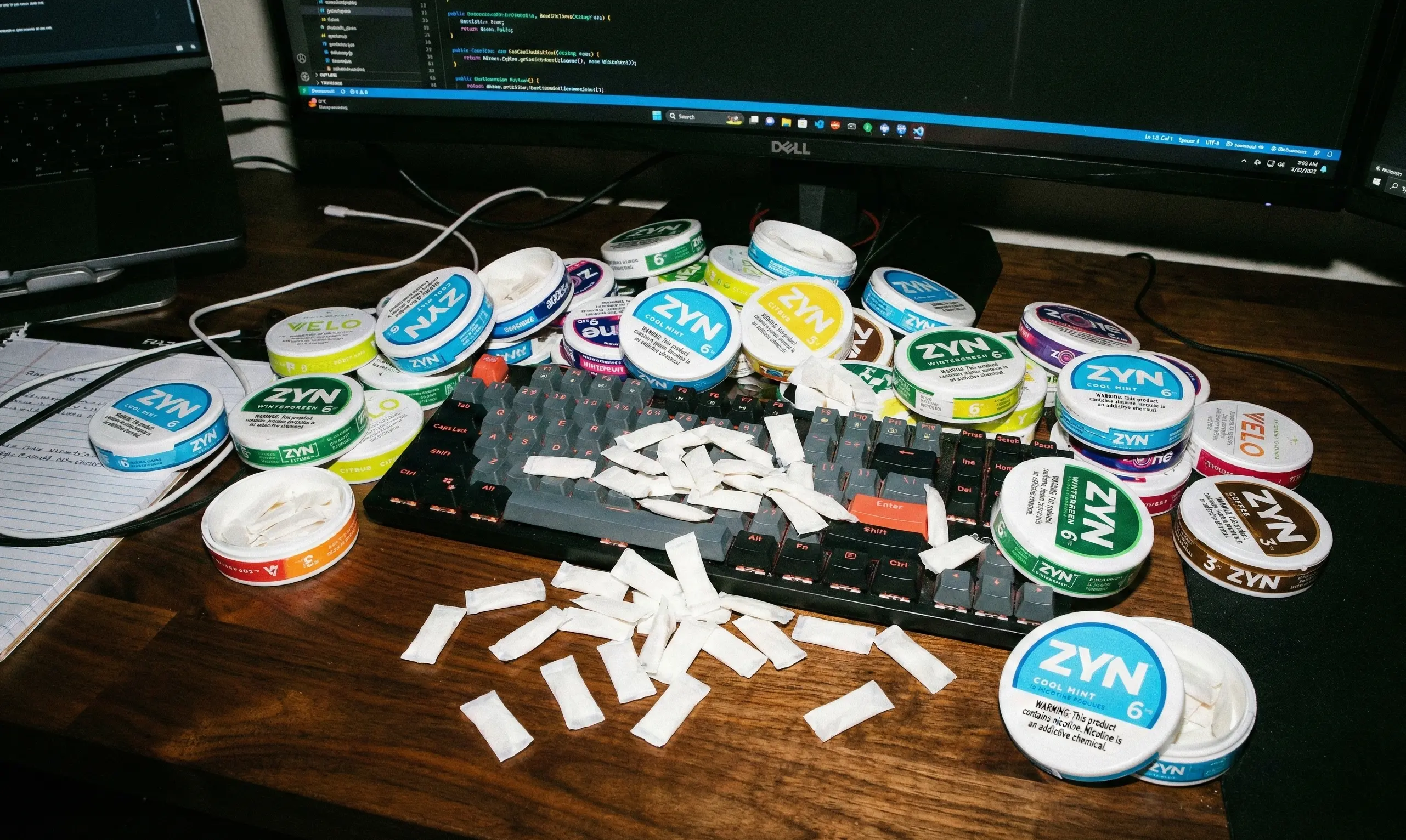
The Zyn Trap
Let's talk about something nobody wants to admit: nicotine pouches have become the productivity drug of choice for a huge swath of knowledge workers, and it's not because people are stupid.
Walk into any tech office, any trading floor, any law firm during deal season, any library during finals week. You'll see the little tins everywhere. Zyn, On!, Velo, Lucy—the brands vary, but the pattern is the same. People who would never smoke cigarettes, who track their sleep and optimize their diets and care deeply about their health, are quietly addicted to nicotine because it's the only thing they've found that actually works.
Call it a market failure. The fact that smart, health-conscious people are choosing addiction as their least-bad option tells you everything you need to know about the state of cognitive enhancement.
Why Nicotine Works
Here's the uncomfortable truth: nicotine is a genuinely effective cognitive enhancer. The research backs this up.
Nicotine binds to acetylcholine receptors in your brain. Acetylcholine is the neurotransmitter most associated with sustained attention, working memory, and the ability to filter out irrelevant information. When you use nicotine, you're essentially boosting the signaling system your brain uses to focus.
The effects are real and measurable. Improved reaction time. Better working memory. Enhanced ability to concentrate on demanding tasks. The subjective experience matches the research: you feel locked in, clear, able to hold a complex problem in your head without your attention constantly fragmenting.
And the delivery method matters. Pouches work better than patches for focus because the absorption is faster and more controllable. You feel it within minutes. There's a ritual—putting the pouch in signals to your brain that it's time to work. By the time you sit down, you're already in a different state.
This is why Zyn spread through knowledge work like wildfire. It's not a placebo. It's not a trend. It genuinely solves a problem that coffee and energy drinks don't.
Why Nicotine Is Still a Terrible Idea
So why not just use nicotine? Because everything else about it is bad.
Addiction is real and fast. Nicotine is one of the most addictive substances known. Most people who use it regularly become dependent within weeks. And nicotine addiction isn't like caffeine addiction—it's not just a headache when you skip your morning dose. It's a persistent, intrusive craving that makes it hard to think about anything else. The thing you started using to focus becomes the thing that destroys your focus when you don't have it.
Tolerance builds quickly. The dose that worked last month doesn't work this month. So you use more. The 3mg pouches become 6mg become 9mg. Some people end up going through multiple tins per day. At that point, you're not enhancing your cognition—you're just maintaining baseline, and baseline keeps getting worse.
Withdrawal is brutal. Try to quit, and you'll experience days or weeks of impaired concentration, irritability, and brain fog. Many people find they can't do demanding cognitive work at all during withdrawal. Which means the very thing you started using nicotine for—the ability to do deep work—becomes hostage to your continued use. You didn't gain a tool. You gained a dependency.
The health effects are not good. Nicotine constricts blood vessels and raises blood pressure. Chronic use is associated with cardiovascular problems. And while pouches are safer than cigarettes (no combustion, no tar, no lung damage), "safer than cigarettes" is a low bar. You're still flooding your system with a vasoconstrictor multiple times per day.
You're funding tobacco companies. Zyn is made by Philip Morris. On! is made by Altria. These companies spent decades lying about the health effects of their products and engineering them to be maximally addictive. Every tin you buy is revenue for an industry that has caused more preventable deaths than almost anything else in human history. Maybe that doesn't bother you. It bothers us.
The Trap
Here's how it usually goes:
You try a nicotine pouch because a friend mentions it helps them focus. You're skeptical—you've never been a smoker, you don't think of yourself as someone who uses nicotine. But you try it, and holy shit, it actually works. That grant deadline that's been looming? You knock it out in one session. That codebase you've been avoiding? Suddenly manageable.
So you use it again. And again. At first, just for important stuff. Then for regular work. Then you notice you're reaching for the tin whenever you sit down at your computer. Then you notice you feel foggy and irritable when you don't have it. Then you realize you've been using it every day for six months and the thought of stopping fills you with dread.
You've accidentally become dependent on a tobacco company's product to do your job.
The worst part? You kind of knew this would happen. Everyone who starts knows nicotine is addictive. But the first few uses feel so consequence-free, and the benefits are so immediate, that you convince yourself you'll be the exception. You won't get addicted. You'll just use it occasionally, for important stuff.
Nobody is the exception.
What We Actually Want
When we talk to people who use Zyn, the story is remarkably consistent. They don't want to be addicted. They don't want to fund tobacco companies. They don't want the health effects. They'd quit tomorrow if they could.
But.But they also don't want to lose the focus. They don't want to go back to fighting their own brain every time they need to do demanding work. They've experienced what it feels like to actually lock in, and they're not willing to give that up.
This is the core tension: nicotine solves a real problem, and there's nothing else on the market that solves it as well. So people stay trapped, choosing addiction over the alternative of not being able to function.
What they actually want is simple: the focus without the addiction. The ritual without the dependency. The locked-in feeling without the cardiovascular effects. Something they can use when they need it and stop using when they don't, without withdrawal symptoms holding them hostage.
The Offramp
This is what we're trying to build.
Not a "quit nicotine" product. Not a cessation aid. Those exist, and they're designed to help you stop using nicotine entirely—which is great if your goal is to quit, but doesn't help if your goal is to actually focus.
We're building something different: a focus pouch that works through different pathways than nicotine, but delivers a similar experience. Fast-acting sublingual absorption. The ritual of putting something in to signal focus time. The feeling of your brain quieting down so you can actually work.
The goal is to give people an offramp—a way to step away from nicotine without stepping away from the thing nicotine was doing for them. You shouldn't have to choose between "addicted but functional" and "free but foggy." That's a false choice created by the absence of good alternatives.
We're calling it NeuroShift.
Why This Is Hard
If it were easy, someone would have done it already. The reason nicotine pouches dominate isn't that the supplement industry hasn't tried to make alternatives—it's that most alternatives don't work. They're either too weak to notice, too slow to be useful, or too inconsistent to rely on.
We're not claiming to have solved this perfectly. What we're claiming is that we think the approach matters: sublingual delivery for speed, the pouch format for ritual, and a focus on quieting cognitive noise rather than just adding stimulation.
Whether that actually works as well as nicotine for the people who currently rely on it—that's what we're trying to find out. And we're not going to pretend we've figured it out until we have actual evidence that people can make the switch.
If This Is You
If you're currently using nicotine pouches and wishing you weren't, we want to hear from you.
How did you start? What have you tried in terms of quitting or cutting back? What's stopped you? If you've tried alternatives, what worked and what didn't?
We're building this for people like you. The more we understand about your experience, the better we can make something that actually helps.
If you want to follow along as we figure this out, you're in the right place. If you have thoughts, we want to hear them.
Nobody should have to choose between addiction and function. We're trying to build the third option.
READY TO UNLOCK YOUR FOCUS?
Subscribe for exclusive discounts and more content like this delivered to your inbox.