NEUROSHIFT STUDY UPDATE: WE TESTED 6 NOOTROPIC STACKS ON OURSELVES (PART 1 OF 3)
NeuroShift Team

NeuroShift Study Update: We Tested 6 Nootropic Stacks On Ourselves (Part 1 of 3)
The first results from our self-experimentation are in, and one formulation stood out: it achieved perfect attention and precision scores while delivering the best cognitive performance across the board.
We Promised You Data. Here It Is.
In our launch post, "Why We're Building a Daily Nootropic," we made a commitment: we wouldn't ask anyone to take something we hadn't tested ourselves, and we'd share what we learn as we learn it.
We also outlined our vision in "Designing the Limitless Pill"—a specification for what the ideal daily nootropic would look like, one that's safe for chronic use without tolerance, dependency, or trade-offs.
Today we're delivering on that promise with the first installment of a three-part series on our initial study data. Did any of these stacks actually make us perform better on objective tests? The short answer is yes—but one stack did something we didn't expect.
The Experiment
We tested six nootropic formulations using a within-subjects crossover design. Each of us (Participant 1 and Participant 2) completed all six conditions on separate days—12 total test sessions.
| Condition | What's In It |
|---|---|
| Placebo | Control (no active ingredients) |
| Caffeine + L-theanine | The classic nootropic combo |
| Theacrine + L-theanine | Caffeine-like effects, reportedly no tolerance |
| Methylliberine + L-theanine | Newer purine alkaloid |
| NeuroShift Alpha | Caffeine + L-theanine + Methylliberine + Theacrine |
| Paraxanthine Stack | Paraxanthine (Enfinity®) + L-theanine + Alpha GPC + Ginseng + B vitamins |
Each session followed the same protocol: baseline cognitive tests before the substance, then the same tests 60 minutes after ingestion.
Study Design
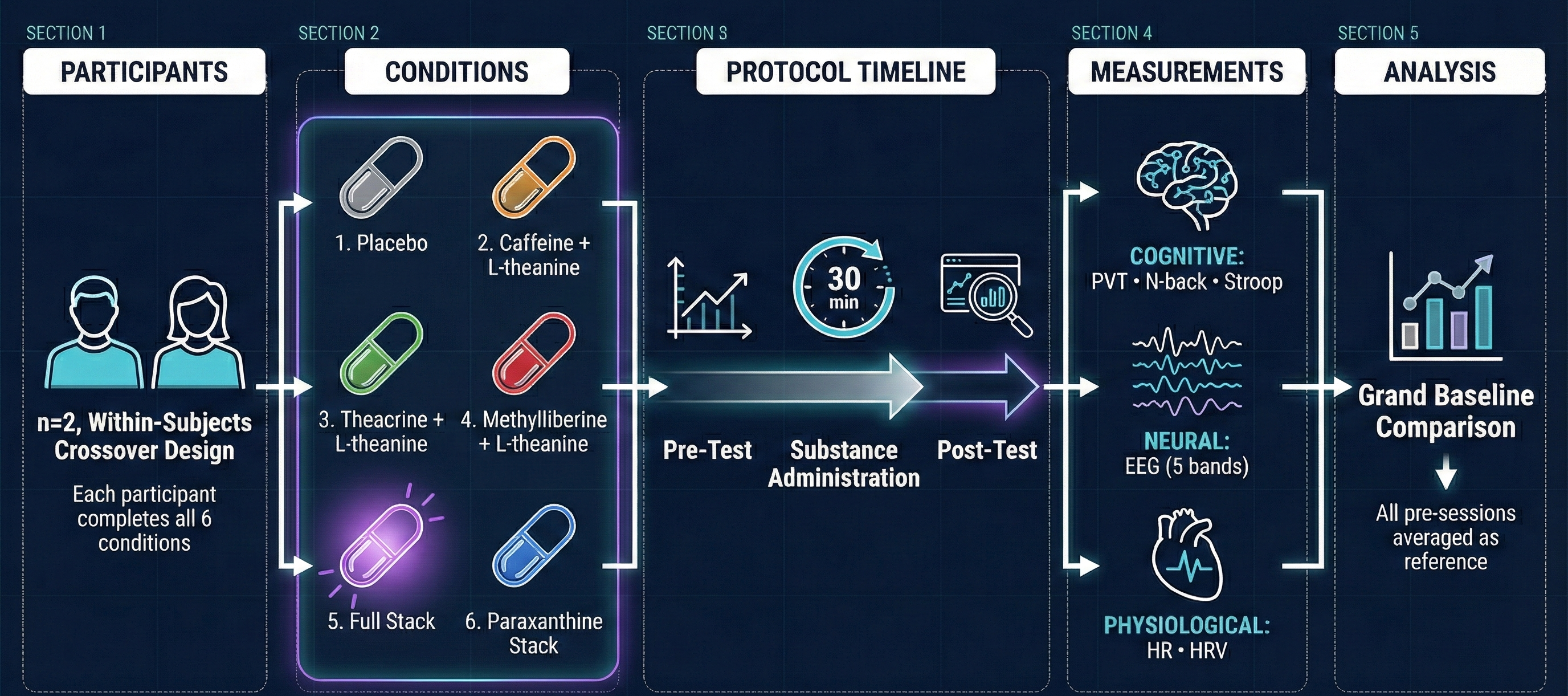
Overview of our within-subjects crossover design. Each participant completed all 6 conditions on separate days. Each session consisted of pre-tests (cognitive battery + physiological monitoring), substance administration, a 60-minute absorption period, and post-tests using identical measures.
All results below compare post-intervention values to a Grand Baseline—the average of all pre-test sessions across all conditions. This gives us a single, consistent reference point for evaluating each intervention.
We measured three types of cognitive performance:
PVT (Psychomotor Vigilance Task) — A 3-minute sustained attention task where you press a button as fast as possible when a stimulus appears. The gold standard for measuring alertness in sleep research. Key metrics: response speed (how fast you react) and sustained attention (percentage of responses within normal range).
N-back (Working Memory) — You see a sequence of letters and press when the current letter matches one from 2 items ago. Demanding—you're constantly updating your mental buffer. Key metrics: d-prime (signal detection ability) and precision (accuracy in distinguishing targets from non-targets).
Stroop Task (Cognitive Control) — You see color words (like "RED") printed in different ink colors and name the ink color, not the word. The cognitive control score measures how effectively you suppress automatic responses to conflicting information.
Results: Comparing All Interventions to Grand Baseline
Figure 1: Cognitive Performance Overview
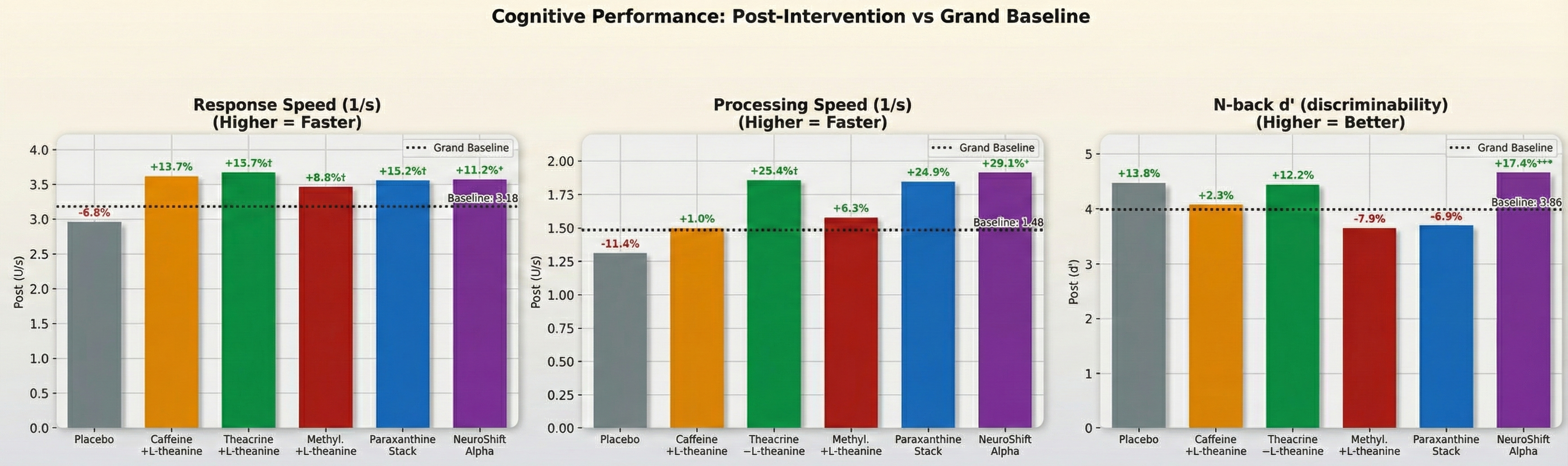
Post-intervention values for three key cognitive metrics. Response Speed: how quickly you respond (higher = faster). Processing Speed: basic cognitive processing (higher = faster). N-back d-prime: working memory signal detection (higher = better). Dashed line shows Grand Baseline. Percentages indicate change vs baseline; green = improvement. Significance: *** p<0.001, ** p<0.01, * p<0.05, † p<0.10.
Response Speed (left): All active interventions produced higher response speeds than baseline. Theacrine + L-theanine showed the highest improvement, followed by Caffeine + L-theanine and NeuroShift Alpha. NeuroShift Alpha was the only intervention with a statistically significant improvement (p=0.03).
Processing Speed (middle): NeuroShift Alpha produced the highest processing speed (p=0.01), followed by Theacrine and Paraxanthine Stack. Caffeine + L-theanine showed slower processing than baseline, and Placebo was dramatically slower—demonstrating fatigue-induced slowing without pharmacological support.
N-back d-prime (right): NeuroShift Alpha produced the best result (+19.3%, p<0.01). This was the largest and only statistically significant d-prime improvement.
Figure 2: Attention Quality
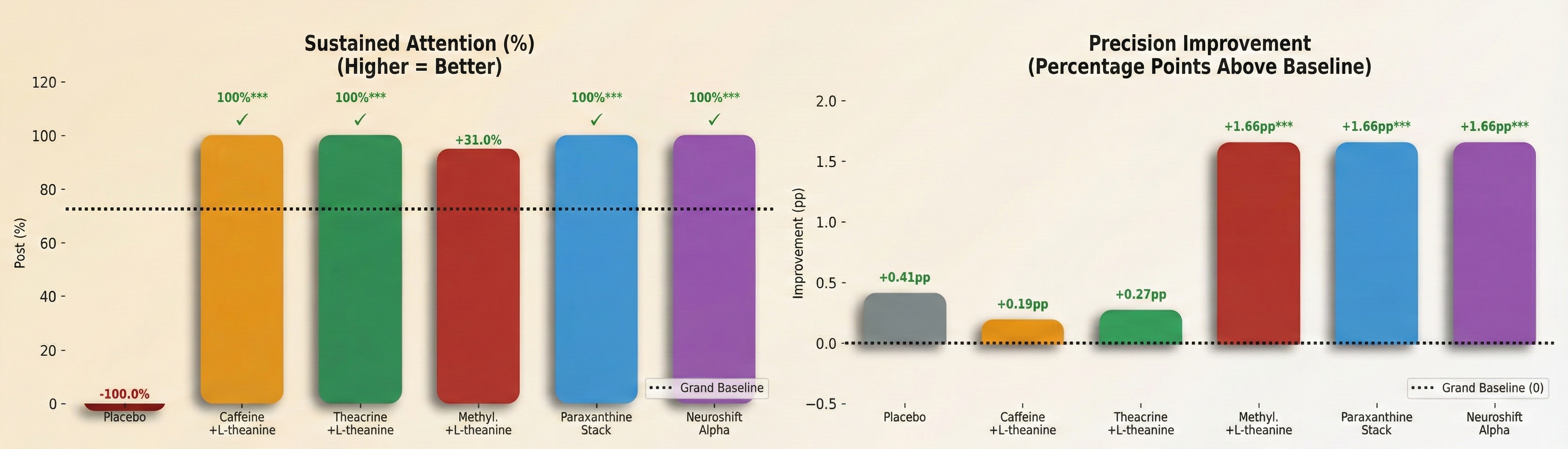
Post-intervention attention quality metrics. Sustained Attention (left): percentage of responses within normal range (higher = better). Precision Improvement (right): percentage points above Grand Baseline (higher = better improvement). Dashed lines show Grand Baseline. Significance: *** p<0.001, ** p<0.01, * p<0.05.
This is the most striking finding from the study.
Sustained Attention (left): NeuroShift Alpha, Theacrine, Caffeine, and Paraxanthine all achieved perfect sustained attention (100%)—complete elimination of attention failures, all statistically significant (p<0.01). Meanwhile, Placebo showed significantly degraded attention, demonstrating cognitive decay over the testing session without pharmacological support.
Precision Improvement (right): NeuroShift Alpha, Paraxanthine Stack, and Methylliberine + L-theanine achieved the highest precision improvements (+1.66 percentage points above baseline, p<0.001). Placebo improved only +0.41pp—meaning NeuroShift Alpha achieved roughly 4× the precision gain. All values were high in absolute terms (~99-100%), but this visualization highlights how much each intervention improved relative to the Grand Baseline.
The key insight is that without pharmacological support, performance degraded during testing. Active interventions didn't just maintain performance—they delivered measurably greater precision gains.
Figure 3: Cognitive Control
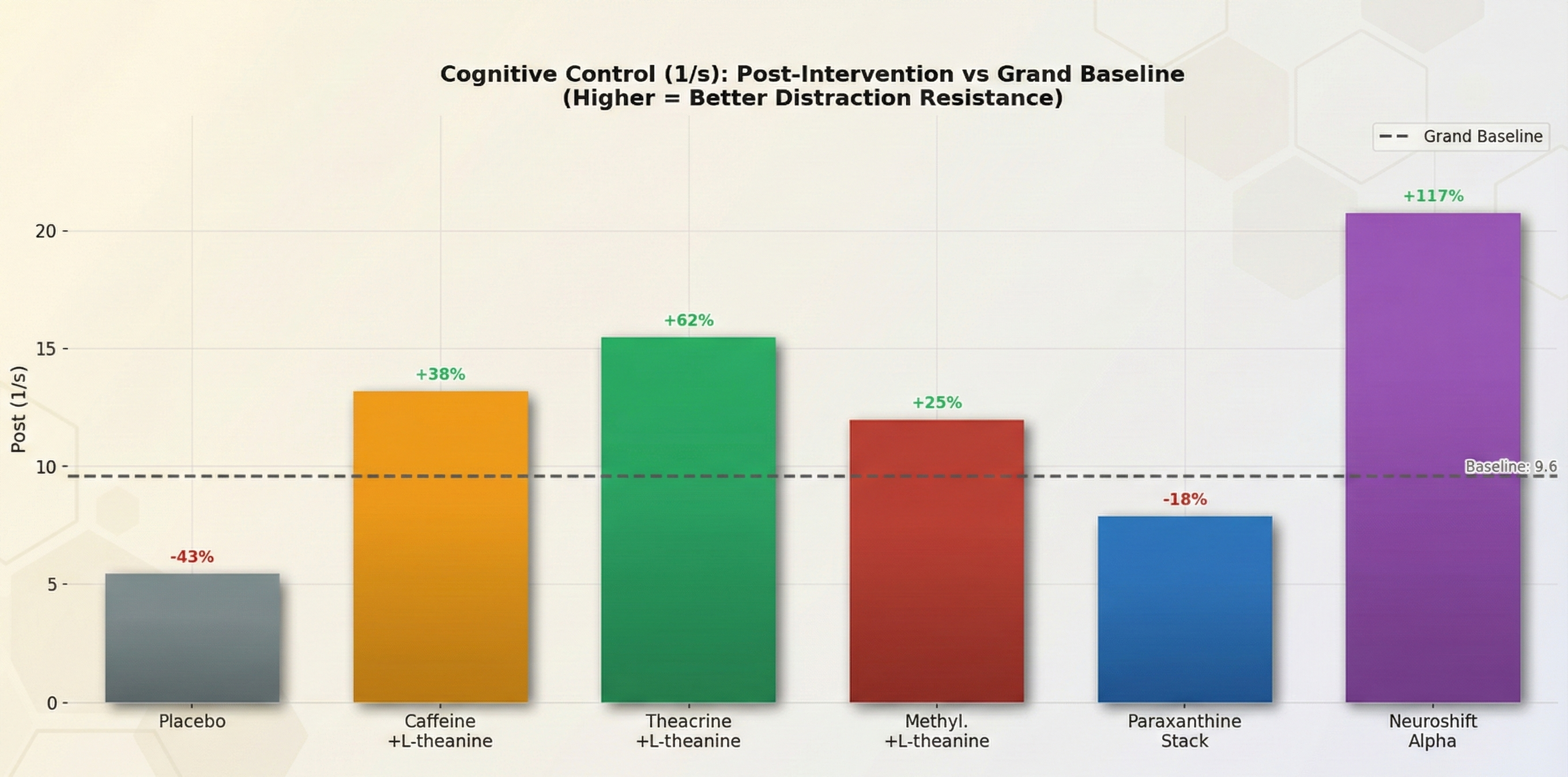
Post-intervention cognitive control scores. Higher scores indicate better ability to suppress automatic responses when facing conflicting information. Dashed line shows Grand Baseline. Percentages indicate change vs baseline.
Cognitive control measures how effectively your brain suppresses automatic responses—higher means better ability to filter out distracting information.
NeuroShift Alpha achieved the highest cognitive control score, substantially above baseline. Theacrine + L-theanine came second, followed by Caffeine + L-theanine.
Placebo showed significantly reduced cognitive control compared to baseline—participants became worse at handling conflicting information over the session. This fatigue effect makes the active interventions' improvements more notable by contrast.
The Ranking
Based on the Grand Baseline comparisons:
| Rank | Intervention | Key Strengths | Significant Findings |
|---|---|---|---|
| 1 | NeuroShift Alpha | Best d-prime (+19.3%), highest cognitive control, perfect attention scores | 4+ significant findings |
| 2 | Theacrine + L-theanine | Highest response speed, good d-prime (+14%), perfect sustained attention | Trending significance |
| 3 | Caffeine + L-theanine | High response speed, decent d-prime (+4%), perfect sustained attention | 1 significant finding |
| 4 | Paraxanthine Stack | Perfect attention scores, good speed, but reduced d-prime (-5.4%) | Mixed profile |
| 5 | Methylliberine + L-theanine | Good response speed, less consistent | Trending |
| 6 | Placebo | Cognitive decay: degraded attention, reduced cognitive control | — |
Why NeuroShift Alpha Wins: Breaking the Stimulant Trade-off
Most cognitive enhancers force a trade-off. Caffeine makes you faster but you make more mistakes. Nicotine sharpens focus but builds tolerance. Speed, accuracy, and consistency usually trade off against each other.
NeuroShift Alpha appears to break this pattern:
| Dimension | Typical Stimulant | NeuroShift Alpha vs Baseline |
|---|---|---|
| Response Speed | ↑ Higher | ↑ Significantly improved |
| Sustained Attention | ↕ Variable | ↑ Perfect (100%) |
| Signal Detection | ↕ Variable | ↑ +19.3% (best d-prime) |
| Precision | ↕ Variable | ↑ Perfect (100%) |
| Cognitive Control | ↕ Variable | ↑ Highest score |
The combination of speed and accuracy improvements is what sets NeuroShift Alpha apart. Other interventions improved one or the other. NeuroShift Alpha improved both.
What We're Not Claiming (Yet)
We're excited about these results, but we know their limitations.
What we can say:
- In this self-experiment (n=2), NeuroShift Alpha produced the best cognitive performance compared to Grand Baseline
- Multiple findings reached statistical significance despite the small sample
- Improvements were consistent between both participants
- NeuroShift Alpha was the only intervention with 4+ statistically significant improvements
What we can't claim yet:
- That this will work for everyone (individual neurochemistry varies)
- That these effects persist over weeks of daily use (we measured single doses)
- That we weren't influenced by knowing what we were takin...
READY TO UNLOCK YOUR FOCUS?
Subscribe for exclusive discounts and more content like this delivered to your inbox.