MATCHA VS. COFFEE: A HEAD-TO-HEAD COMPARISON FOR FOCUS, ENERGY, AND HEALTH
Roon Team
Matcha vs. Coffee: A Head-to-Head Comparison for Focus, Energy, and Health
The matcha vs coffee debate is doing more than splitting opinions about morning drinks. It's shaping how people think about focus, energy curves, and stress response for the entire day. With the global matcha market now valued at over $4 billion in 2025 and coffee still dominating as the world's most consumed stimulant, the question isn't which one tastes better. It's which one actually performs better.
This matcha vs coffee comparison breaks down the caffeine content, health benefits, energy profiles, and practical tradeoffs of both drinks, so you can make a decision based on data instead of habit.
Key Takeaways
- Caffeine content is closer than you think: A standard matcha serving contains 38–176 mg of caffeine depending on preparation, compared to coffee's 80–100 mg per cup.
- Matcha delivers calmer, longer-lasting energy thanks to L-theanine, an amino acid that slows caffeine absorption and promotes alpha brain wave activity.
- Coffee hits harder but crashes faster, and it raises cortisol levels more than tea-based caffeine sources.
- Both have strong antioxidant profiles, but the benefits of matcha vs coffee work through completely different mechanisms.
Matcha Caffeine vs Coffee: The Real Numbers
The first thing most people want to know about matcha vs coffee is simple: which one has more caffeine?
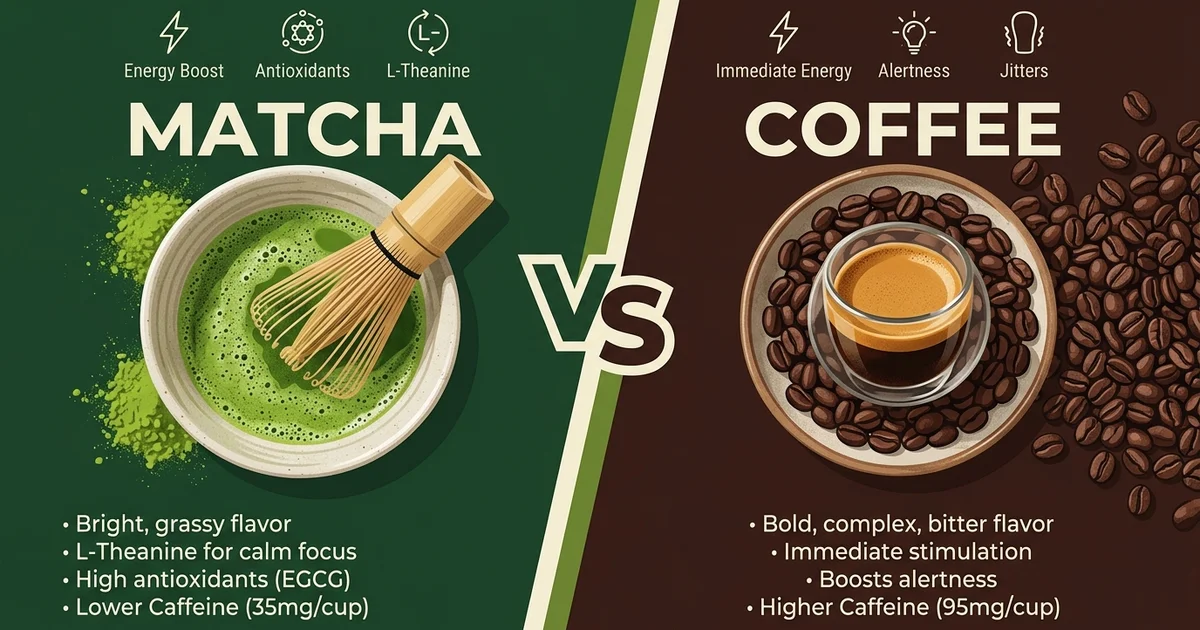
The answer depends on how you prepare it. According to Healthline, matcha contains 19 to 44 mg of caffeine per gram of powder. A typical serving uses 2 to 4 grams, putting a single cup anywhere between 38 and 176 mg. A standard 8-ounce cup of brewed coffee lands between 80 and 100 mg.
So if you're using a full teaspoon of matcha (about 4 grams), you're actually getting more caffeine than a cup of drip coffee. With a half-teaspoon, you're getting less. The preparation matters.
But the matcha caffeine vs coffee debate doesn't end with milligrams. The way your body absorbs and processes that caffeine is where the two diverge sharply.
How Matcha vs Coffee Energy Delivery Differs
Coffee's caffeine hits your bloodstream fast. You feel the spike within 15 to 45 minutes. That rapid onset is what makes it effective, but it's also what causes the jitters and the afternoon crash that sends you back for cup number two (or three).
Matcha works on a different timeline. The amino acid L-theanine, which is abundant in shade-grown matcha leaves, slows the absorption of caffeine and promotes a sustained energy window of 3 to 6 hours. L-theanine also triggers alpha brain wave activity, the same pattern associated with calm, focused attention.
A study published in Nutritional Neuroscience found that a combination of 97 mg of L-theanine and 40 mg of caffeine helped participants focus attention during demanding cognitive tasks. That ratio, high L-theanine paired with moderate caffeine, mirrors what you get in a well-prepared cup of matcha. This is one of the clearest advantages in the matcha vs coffee comparison.
Coffee doesn't contain L-theanine. So while it delivers a stronger initial push, it lacks the built-in modulation that keeps matcha's energy smooth and steady. Understanding caffeine matcha vs coffee means looking beyond the dose and into the delivery mechanism.
The Cortisol Factor
Here's something most matcha vs coffee comparisons skip: coffee raises your cortisol levels. A review presented at the 2025 Joint Congress of ESPE and ESE analyzed studies covering roughly 2,500 subjects and found that coffee caused the strongest cortisol increase among caffeinated beverages, up to 50% above baseline.
Cortisol is your body's primary stress hormone. Elevated cortisol doesn't just make you feel wired. Over time, it can disrupt sleep, increase fat storage, and impair recovery. If you're drinking coffee on an empty stomach first thing in the morning, when cortisol is already naturally elevated, you're stacking stimulation on top of stress.
Matcha's L-theanine content appears to buffer this effect, promoting alertness without the same hormonal spike. This cortisol difference is a key factor in the caffeine matcha vs coffee discussion that most people overlook.
Health Benefits of Matcha vs Coffee
Both drinks are loaded with bioactive compounds. But the benefits of matcha vs coffee target different pathways.
Matcha's Antioxidant Edge
Matcha's star compound is EGCG (epigallocatechin gallate), a catechin with well-documented effects on cellular protection and metabolic function. Because you're consuming the whole tea leaf ground into powder, you get a far higher concentration of catechins than you would from steeped green tea. According to Japan Heartful Store's review of the research, matcha contains 137 times more EGCG than regular green tea.
EGCG has been studied for its role in supporting cardiovascular health, metabolic function, and oxidative stress reduction.
Coffee's Antioxidant Profile
Coffee isn't an antioxidant slouch. Its primary bioactive compounds are chlorogenic acids, which have been linked to improved insulin sensitivity and reduced risk markers for type 2 diabetes and cardiovascular disease. For many Western diets, coffee is actually the single largest source of dietary antioxidants, not because it's the most potent, but because people drink so much of it.
When weighing the benefits of matcha vs coffee from an antioxidant standpoint, the winner depends on which bioactive compounds matter most for your goals.
Side-by-Side Matcha vs Coffee Comparison
| Factor | Matcha | Coffee |
|---|---|---|
| Caffeine per serving | 38–176 mg | 80–100 mg |
| L-Theanine | Yes (naturally occurring) | No |
| Primary antioxidant | EGCG (catechins) | Chlorogenic acids |
| Energy duration | 3–6 hours, gradual | 1–3 hours, sharp peak |
| Crash/jitters | Minimal | Common |
| Cortisol impact | Lower | Higher (up to 50% above baseline) |
| Teeth staining | Less (lower tannins) | More (dark pigments, higher acidity) |
| Prep time | 2–3 min (whisk or shake) | 1–5 min (varies by method) |
The Tolerance Problem
There's a practical issue that rarely comes up in the matcha vs coffee conversation: tolerance.
Coffee works primarily by blocking adenosine receptors in your brain. Adenosine is the molecule that builds up throughout the day and makes you feel sleepy. Caffeine parks itself in those receptors, preventing adenosine from doing its job. That's why coffee makes you feel alert.
But your brain adapts. As explained by Ultrahuman's research review, the brain responds to chronic caffeine intake by upregulating adenosine receptors, creating more docking sites for adenosine. The result: you need more caffeine to get the same effect. This is why your one-cup habit quietly becomes a three-cup habit.
Matcha's caffeine triggers the same adenosine-blocking mechanism, so the matcha caffeine vs coffee tolerance story isn't entirely one-sided. But because L-theanine modulates the stimulant effect and the per-serving caffeine dose tends to be lower, many users report a more stable relationship with matcha over time.
Practical Matcha vs Coffee Tradeoffs: Cost, Convenience, and Taste
Let's be honest about the downsides.
Matcha is expensive. Ceremonial-grade matcha runs $0.75 to $2.00 per serving. A cup of home-brewed coffee costs $0.15 to $0.30. If budget is your primary concern, coffee wins by a wide margin.
Matcha requires more effort. You need a whisk or a shaker bottle, and the powder can clump if you don't mix it properly. Coffee is easier to automate with a drip machine or pod system.
Taste is subjective, but polarizing. Matcha has a vegetal, slightly bitter, umami-forward flavor that some people love and others can't stand. Coffee's bitter-roasted profile is more universally familiar.
On the flip side, matcha stains teeth less than coffee due to its lower tannin content and reduced acidity. If you're drinking multiple cups a day, that difference adds up.
Beyond the Matcha vs Coffee Debate: What If Neither Is the Best Option?
The benefits of matcha vs coffee are real. Both are legitimate cognitive tools backed by decades of research. But both also come with friction: preparation time, caloric additions (milk, sugar, syrups), temperature requirements, and the simple inconvenience of needing a cup in your hand.
There's a third category worth considering: purpose-built cognitive performance products that combine the best elements of both, without the downsides.
Roon is a zero-nicotine sublingual pouch that pairs 40 mg of caffeine with L-theanine, theacrine, and methylliberine, a stack designed for 4 to 6 hours of sustained focus with no crash and no tolerance buildup. A study published in Cureus found that the combination of caffeine, theacrine, and methylliberine improved speed, accuracy, and cognitive performance compared to caffeine alone.
No brewing. No cups. No stained teeth. Just the active compounds, delivered sublingually for faster absorption.
If you've been going back and forth in the matcha vs coffee debate, it might be worth looking at what happens when you skip the beverage entirely and go straight to the ingredients that matter. See how Roon compares.
READY TO UNLOCK YOUR FOCUS?
Subscribe for exclusive discounts and more content like this delivered to your inbox.