NATURAL SUPPLEMENTS FOR MENOPAUSE BRAIN FOG: WHAT ACTUALLY WORKS
Roon Team
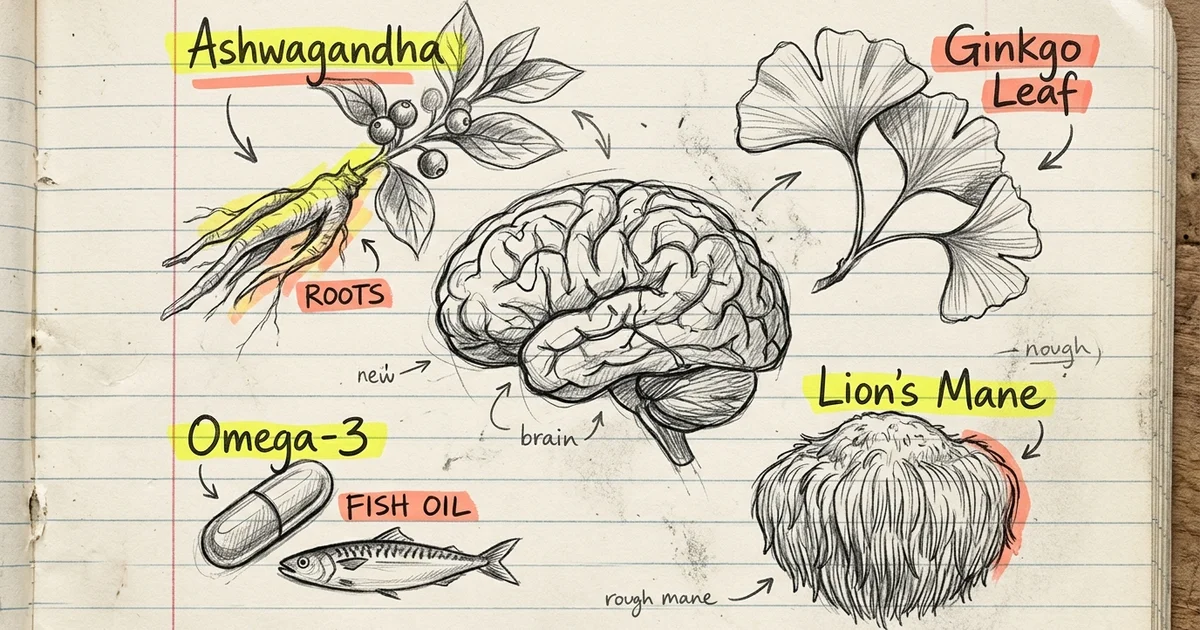
Natural Supplements for Menopause Brain Fog: What Actually Works
You're mid-sentence in a meeting and the word just... vanishes. You walked into the kitchen with purpose, and now you're standing there holding a spatula with no idea why. If this sounds familiar, you may already be searching for natural supplements for menopause brain fog, and you're far from alone.
Research shows that up to 60 percent of women experience cognitive difficulties during menopause, according to a 2025 report from RAND. The struggle with memory, focus, and mental clarity is real, measurable, and rooted in neuroscience. The good news: natural supplements for menopause brain fog can help. But the supplement aisle is a minefield of overpriced placebos. Here's what the science actually supports.
Key Takeaways:
- Menopause brain fog is driven by declining estrogen, which disrupts neurotransmitter systems including dopamine, serotonin, and acetylcholine.
- Several natural supplements for menopause brain fog have strong clinical evidence for supporting cognitive function during this transition.
- The best results come from targeting specific neurochemical pathways, not from taking a random multivitamin and hoping for the best.
- Combining complementary compounds (like caffeine + L-theanine) tends to outperform single-ingredient approaches.
Why Menopause Causes Brain Fog in the First Place
Before you can choose the right natural supplements for menopause brain fog, you need to understand the problem itself. Brain fog during menopause isn't a vague "feeling." It's a neurochemical event.
Estrogen does far more than regulate your reproductive system. It acts as a master regulator for multiple neurotransmitter systems in the brain. As estrogen declines during perimenopause and menopause, it directly impacts the production and signaling of serotonin, dopamine, and acetylcholine, the three chemicals most responsible for mood, motivation, and memory.
A review published in PMC found that estrogen decline reduces serotonin receptor expression, impairs dopaminergic signaling, and diminishes GABAergic activity. The hippocampus (your memory center) and prefrontal cortex (your focus and decision-making hub) are both dense with estrogen receptors. When estrogen drops, these regions take the hit first.
This is why menopause brain fog feels so specific. It's not general fatigue. It's the tip-of-the-tongue word retrieval failures. It's reading the same paragraph three times. It's forgetting why you opened a browser tab four seconds ago.
Sleep disruption compounds the problem. Hot flashes and night sweats fracture sleep architecture, and poor sleep further degrades the dopamine and acetylcholine systems that are already running low. It becomes a feedback loop: hormonal changes disrupt neurotransmitters, which disrupt sleep, which further disrupts neurotransmitters.
The key insight here: any natural supplements for menopause brain fog worth taking need to work on these downstream neurotransmitter systems. Estrogen itself isn't the only lever you can pull.
Natural Supplements for Menopause Brain Fog With Real Evidence
Let's cut through the noise. These are the compounds with actual clinical data supporting their use for cognitive function, particularly the types of cognitive issues that show up during menopause.
L-Theanine: The Attention Sharpener
L-theanine is an amino acid found naturally in green tea. It crosses the blood-brain barrier and modulates GABA, serotonin, and dopamine activity, which makes it directly relevant to the neurotransmitter disruption caused by estrogen decline. That's why L-theanine ranks among the most promising natural supplements for menopause brain fog.
A randomized, placebo-controlled study published in PMC found that a single dose of L-theanine improved attention and enhanced working memory and executive function in middle-aged and older subjects. A meta-analysis of randomized controlled trials confirmed a dose-dependent effect on cognitive function, with measurable improvements in visual information processing and reaction time.
L-theanine works best when your brain is under stress, exactly the kind of conditions menopause creates.
Caffeine + L-Theanine: Better Together
Caffeine alone is a blunt instrument. It blocks adenosine receptors (the "sleepiness" signal), which increases alertness. But it also raises cortisol and can spike anxiety, something many menopausal women are already battling.
The combination of caffeine and L-theanine solves this. A study published in PubMed found that 97 mg of L-theanine combined with 40 mg of caffeine improved focus during demanding cognitive tasks. The L-theanine smooths out caffeine's rough edges, promoting calm alertness instead of jittery wakefulness.
A PMC review of the combination's effects noted that L-theanine modulates GABA levels while caffeine increases glutamate, creating complementary neurochemical effects that support sustained attention without the crash.
This pairing is one of the most well-studied nootropic stacks in existence, and one of the most accessible natural supplements for menopause brain fog. It's not exotic. It's not trendy. It just works.
For women in menopause, the combination is especially relevant because L-theanine addresses the GABA and serotonin disruption from estrogen decline, while caffeine tackles the fatigue and sluggish processing speed that come with poor sleep and low dopamine.
Theacrine: Caffeine's Longer-Lasting Cousin
Theacrine is structurally similar to caffeine and acts on the same adenosine receptors, but with a key difference: it appears to produce less tolerance buildup over time. That means you don't need to keep increasing the dose to get the same effect.
A 2025 study published in the Journal of the International Society of Sports Nutrition found that a caffeine-theacrine combination mitigated deficits in attention and inhibitory control under fatiguing conditions. A separate PMC study comparing theacrine-containing supplements to caffeine alone found improvements in cognitive performance, energy, and mood in both men and women.
For menopausal brain fog specifically, theacrine's ability to support alertness without escalating tolerance makes it a strong candidate for daily use and a worthy addition to any list of natural supplements for menopause brain fog.
Omega-3 Fatty Acids (DHA): The Structural Foundation
DHA is the most abundant omega-3 fatty acid in the brain, making up roughly 30-40% of the fatty acids in the cerebral cortex. It supports cell membrane fluidity, neurotransmitter signaling, and neuroinflammation control.
Multiple studies have linked higher DHA intake to better cognitive performance in aging populations. For menopausal women, whose brains are already under neurochemical stress, maintaining adequate DHA levels is foundational. Think of it as keeping the hardware in good shape while other natural supplements for menopause brain fog optimize the software.
Aim for at least 500-1000 mg of combined EPA/DHA daily from fish oil or algae-based supplements. If you eat fatty fish (salmon, sardines, mackerel) two to three times per week, you may already be covered. If not, supplementation fills a real gap.
Magnesium: The Overlooked Essential
Magnesium is involved in over 300 enzymatic reactions in the body, including many that regulate neurotransmitter release and synaptic plasticity. Subclinical magnesium deficiency is common, especially in women over 40, and it can worsen cognitive symptoms. That makes magnesium one of the most underrated natural supplements for menopause brain fog.
Magnesium L-threonate is the form with the most evidence for crossing the blood-brain barrier and supporting brain function. If you're experiencing brain fog alongside poor sleep (another hallmark of menopause), magnesium is worth adding to your stack.
Bacopa Monnieri: The Memory Herb
Bacopa monnieri has been used in Ayurvedic medicine for centuries, and modern research has caught up. Multiple clinical trials show improvements in memory acquisition and retention after 8-12 weeks of supplementation. It works by modulating acetylcholine and serotonin, both of which are disrupted during menopause, making bacopa another evidence-backed option among natural supplements for menopause brain fog.
The catch: bacopa takes time. Don't expect results in a week. This is a long-game supplement that builds cognitive support gradually.
Natural Supplements for Menopause Brain Fog: What to Avoid
Not everything on the shelf deserves your money. A few categories to approach with skepticism:
Single-ingredient "brain pills" at low doses. Many commercial brain supplements include the right ingredients at doses too small to do anything. Check the label. If a product contains 10 mg of L-theanine, that's decorative, not functional.
Proprietary blends that hide doses. If a supplement lists a "proprietary blend" of 500 mg containing six ingredients, you have no idea how much of each you're actually getting. Transparency matters, especially when evaluating natural supplements for menopause brain fog.
Anything promising to "reverse" menopause symptoms. No supplement reverses the hormonal changes of menopause. What good natural supplements for menopause brain fog do is support the neurotransmitter systems that those hormonal changes disrupt. That's a meaningful distinction.
Ginkgo biloba at standard doses. While ginkgo has a long reputation as a "memory herb," the clinical evidence for cognitive improvement in otherwise healthy adults is weak. Most positive studies involved populations with existing cognitive impairment, not the everyday brain fog of menopause.
Building a Smart Supplement Stack
The most effective approach to choosing natural supplements for menopause brain fog combines compounds that work on different pathways:
| Supplement | Primary Mechanism | Best For | Onset |
|---|---|---|---|
| L-Theanine | GABA/serotonin/dopamine modulation | Calm focus, reduced anxiety | 30-60 minutes |
| Caffeine (low dose) | Adenosine receptor blocking | Alertness, reaction time | 15-30 minutes |
| Theacrine | Adenosine + dopamine modulation | Sustained energy without tolerance | 30-60 minutes |
| Omega-3 (DHA) | Cell membrane support | Long-term brain health | 4-8 weeks |
| Magnesium L-threonate | Synaptic plasticity | Sleep quality, cognitive clarity | 1-2 weeks |
| Bacopa monnieri | Acetylcholine/serotonin modulation | Memory retention | 8-12 weeks |
Notice the pattern: some of these natural supplements for menopause brain fog work fast (caffeine, L-theanine, theacrine) while others build over weeks. A good stack includes both.
The fast-acting compounds handle the daily fog. The slower-building ones create a stronger cognitive baseline over time.
One more thing worth noting: lifestyle factors multiply the effects of any supplement stack. Regular exercise (even 30 minutes of walking) increases BDNF, a protein that supports neuron growth and survival. Quality sleep, even when menopause makes it harder, remains the single most powerful cognitive tool you have. Natural supplements for menopause brain fog work best when the basics are covered.
Cut Through the Fog
Menopause brain fog is a neurotransmitter problem, and the most effective natural supplements for menopause brain fog target those neurotransmitters directly.
That's the exact logic behind Roon, a zero-nicotine sublingual pouch built around four compounds that work on the pathways most disrupted by hormonal changes: caffeine (40 mg), L-theanine, theacrine, and methylliberine. Together, they modulate adenosine, GABA, and dopamine signaling, the same systems that estrogen decline throws off balance.
No crash. No jitters. No tolerance buildup. Just 4-6 hours of clean, sustained focus, delivered sublingually for faster absorption than capsules or drinks.
If your brain hasn't felt like yours lately, it might be time to give it what it's actually missing. Try Roon today.
READY TO UNLOCK YOUR FOCUS?
Subscribe for exclusive discounts and more content like this delivered to your inbox.