BRAIN FUNCTION SUPPLEMENTS: A SCIENCE-BASED GUIDE TO WHAT ACTUALLY WORKS
Roon Team
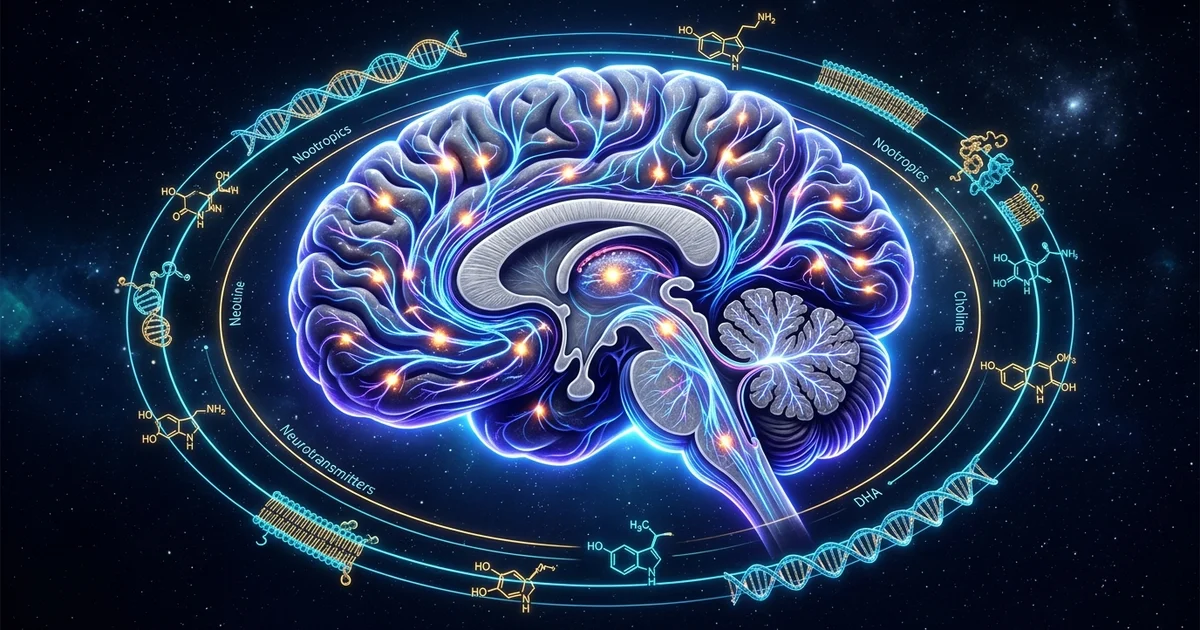
Brain Function Supplements: A Science-Based Guide to What Actually Works
Most brain function supplements don't work. That's the uncomfortable truth behind a market projected to reach $23.52 billion by 2030. Hundreds of products line the shelves at your local pharmacy, each promising sharper thinking and better recall. But when you strip away the marketing language and look at clinical data, only a handful of brain function supplements have real evidence behind them.
This guide breaks down the best supplements for brain health and memory based on published research, not hype. You'll learn which brain function supplements actually improve cognition, which ones waste your money, and how to build a stack that delivers measurable results.
Key Takeaways:
- Only a small number of brain function supplements have strong clinical evidence for cognitive benefits in healthy adults.
- The combination of caffeine and L-theanine is one of the most well-studied nootropic pairings, with measurable improvements in attention and task switching.
- Newer compounds like theacrine and methylliberine extend the duration of cognitive benefits without the tolerance buildup of caffeine alone.
- Most "top 10 brain supplements" lists include ingredients with weak or inconsistent evidence. Know the difference.
What Makes Good Brain Function Supplements? (And Why Most Fail)
Harvard Health has stated plainly that existing research has found no solid proof most brain health supplements work. That's a broad claim, but it reflects a real problem: the supplement industry doesn't require the same level of evidence as pharmaceuticals. Companies can sell brain function supplements with minimal proof of efficacy.
A good brain function supplement needs three things:
- Ingredients backed by randomized, controlled trials (not just animal studies or in-vitro data).
- Clinically effective dosages, not pixie-dusted amounts hidden behind proprietary blends.
- A mechanism of action that makes biological sense, meaning the compound actually crosses the blood-brain barrier and interacts with relevant neurotransmitter systems.
With those criteria in mind, here's what the science supports.
The Best Brain Function Supplements for Memory and Focus: What the Research Says
Caffeine + L-Theanine: The Foundation
If you're looking for brain supplements for memory and attention, start here. Caffeine is the world's most consumed psychoactive substance, and for good reason. It blocks adenosine receptors, reducing fatigue and increasing alertness. But caffeine alone has downsides: jitters, anxiety, and an energy crash when it wears off.
L-theanine, an amino acid found naturally in tea leaves, solves most of those problems. A study published in Nutritional Neuroscience found that combining moderate levels of L-theanine and caffeine improved accuracy during task switching and increased self-reported alertness, while reducing tiredness. The effects were statistically significant (p < 0.01 for both measures).
A systematic review published in Cureus confirmed these findings across multiple studies, showing improvements in composite cognition scores and inhibitory control when the two compounds were taken together. This pairing consistently ranks among the best supplements for brain health and memory in evidence-based reviews.
The ratio matters. Research suggests a 2:1 ratio of L-theanine to caffeine is effective for optimizing cognitive function. So if you're taking 40mg of caffeine, you'd pair it with roughly 80mg of L-theanine.
This isn't a subtle effect. The combination produces cleaner focus than coffee, without the racing heart or the 2pm wall. It's also why L-theanine shows up in virtually every serious brain function supplement on the market. The data is that consistent.
What's less discussed: L-theanine promotes alpha brain wave activity, the same pattern associated with calm, alert focus. Think of the mental state you're in when you're deeply absorbed in a task but not stressed about it. That's alpha wave territory, and L-theanine nudges your brain in that direction while caffeine keeps the lights on. For brain supplements for memory, this calm-focus state is exactly the environment where recall improves.
Theacrine and Methylliberine: The Extended-Release Layer
Here's where brain function supplements get interesting. Caffeine and L-theanine are a solid foundation, but caffeine has a well-known weakness: tolerance. Your body adapts to it within days, requiring higher doses for the same effect.
Theacrine (sold commercially as TeaCrine) is a purine alkaloid structurally similar to caffeine. It activates dopamine receptors and adenosine pathways, but with a critical difference. A study published in the Journal of the International Society of Sports Nutrition found that even after 8 weeks of daily use at 300mg, participants showed no signs of tolerance, dependency, or withdrawal. That's a stark contrast to caffeine, where habituation can set in within a week.
Methylliberine (branded as Dynamine) is a metabolite of caffeine with a faster onset. It hits quickly, while theacrine sustains the effect over a longer window.
A 2021 study published in Cureus tested the combination of caffeine, theacrine, and methylliberine in a randomized crossover trial. The results showed that this three-compound stack improved cognitive performance and reaction time without increasing anxiety or headaches. A follow-up study on recreational gamers found the combination improved cognitive and motor abilities, and the addition of theacrine and methylliberine to caffeine appeared to reduce some of caffeine's undesirable side effects on cognitive control.
A trial on tactical personnel showed similar efficacy of the combined caffeine-theacrine-methylliberine stack compared to double the caffeine dose consumed alone on vigilance reaction time, but without a significant rise in blood pressure.
That's the real advantage of these brain function supplements: you get the same (or better) cognitive output with less stimulant load and no tolerance curve.
Omega-3 Fatty Acids (DHA/EPA): The Long Game
Omega-3s aren't a quick-hit focus supplement. They're a long-term investment in brain structure. DHA makes up a large portion of the polyunsaturated lipids in brain cell membranes and plays a direct role in neurotransmission.
A 2025 dose-response meta-analysis published in Scientific Reports found that omega-3 supplementation at 2,000mg per day showed significant improvements in attention and perceptual speed. A study from UT Health San Antonio linked higher omega-3 levels to improved brain structure and cognition at midlife. That's why omega-3s appear on any credible list of the best supplements for brain health and memory.
The catch: you need to take them consistently for months before seeing cognitive benefits. This isn't the brain function supplement that sharpens your focus for a Tuesday afternoon meeting. It's the one that keeps your brain functioning well at 60.
Creatine: Not Just for the Gym
Most people associate creatine with muscle building. But your brain is one of the most energy-demanding organs in your body, and creatine plays a direct role in cellular energy production. That makes it one of the more underrated brain function supplements available.
A 2024 systematic review and meta-analysis published in Frontiers in Nutrition evaluated the effects of creatine monohydrate on cognitive function across multiple randomized controlled trials. The analysis found improvements in memory and processing speed, with the strongest effects in older adults and individuals under cognitive stress (like sleep deprivation). For anyone searching for brain supplements for memory, creatine deserves serious consideration.
Examine.com's analysis of the same data noted that age was a major factor: older adults saw the clearest benefits. For younger, well-rested adults, the effects were more modest.
Creatine is inexpensive and safe. If you're over 40 or regularly sleep-deprived, it belongs in your stack.
Brain Function Supplements That Don't Live Up to the Hype
Not everything marketed as a brain booster deserves the label. Here are common ingredients found in brain function supplements that fall short:
| Ingredient | The Claim | The Reality |
|---|---|---|
| Ginkgo Biloba | Improves memory and blood flow to the brain | Mixed results in trials. Most large studies show no benefit for healthy adults. |
| Bacopa Monnieri | Enhances memory consolidation | Some positive data, but effects take 8-12 weeks and study quality varies. |
| Phosphatidylserine | Supports cell membrane health | Limited evidence in healthy populations. Older studies used bovine-derived forms no longer available. |
| "Proprietary Blends" | Various claims | Impossible to evaluate. If a company won't tell you how much of each ingredient is in the product, that's a red flag. |
This doesn't mean these ingredients are useless. It means the evidence isn't strong enough to recommend them with confidence over the brain function supplements listed above. If you see a "top 10 brain supplements" list filled with these ingredients and nothing else, be skeptical.
The supplement industry thrives on ambiguity. Phrases like "supports brain health" can mean almost anything, and they often mean nothing measurable. The brain function supplements worth your money are the ones with dose-specific, placebo-controlled human trials showing clear cognitive outcomes.
How to Build a Brain Function Supplement Stack That Works
If you're serious about cognitive performance, here's a framework based on the research:
For immediate focus (within 15-30 minutes):
- Caffeine (40-100mg) paired with L-theanine at a 2:1 ratio
- Theacrine (100-200mg) and methylliberine for extended duration without tolerance
For long-term brain health:
- Omega-3s (at least 1,000mg DHA/EPA daily)
- Creatine monohydrate (3-5g daily)
What to avoid:
- Products with proprietary blends that hide dosages
- Anything promising overnight memory improvement
- Mega-dose stimulant formulas that spike your heart rate
The best brain function supplements work because they target specific, well-understood mechanisms: adenosine receptor modulation, alpha brain wave promotion, cellular energy production, and structural membrane support. Anything beyond that is marketing. Any top 10 brain supplements ranking that ignores these mechanisms is just guesswork.
One more thing: delivery format matters. A capsule that has to pass through your digestive system takes 30-45 minutes to hit your bloodstream. A sublingual delivery (under the tongue) bypasses the gut entirely, reaching circulation faster and with less degradation. If speed of onset matters to you, the best supplements for brain health and memory come in sublingual options over standard pills.
Invest in Your Brain with the Right Brain Function Supplements
Your brain runs every system in your body. It processes 70,000 thoughts a day, manages your emotional responses, and stores decades of memories. It deserves better than a gas station energy drink or a handful of unproven capsules. Choosing the right brain function supplements is one of the simplest ways to support the organ that matters most.
Roon was built around the exact ingredient stack the research supports: 40mg of caffeine, L-theanine, theacrine, and methylliberine, delivered as a sublingual pouch for faster absorption. No nicotine. No jitters. No crash. And because theacrine doesn't build tolerance, it works just as well on day 90 as it does on day one.
If the science in this article resonated with you, try Roon and feel the difference for yourself.
READY TO UNLOCK YOUR FOCUS?
Subscribe for exclusive discounts and more content like this delivered to your inbox.