WHICH IS THE BEST MAGNESIUM FOR SLEEP? 6 FORMS, RANKED BY SCIENCE
Roon Team
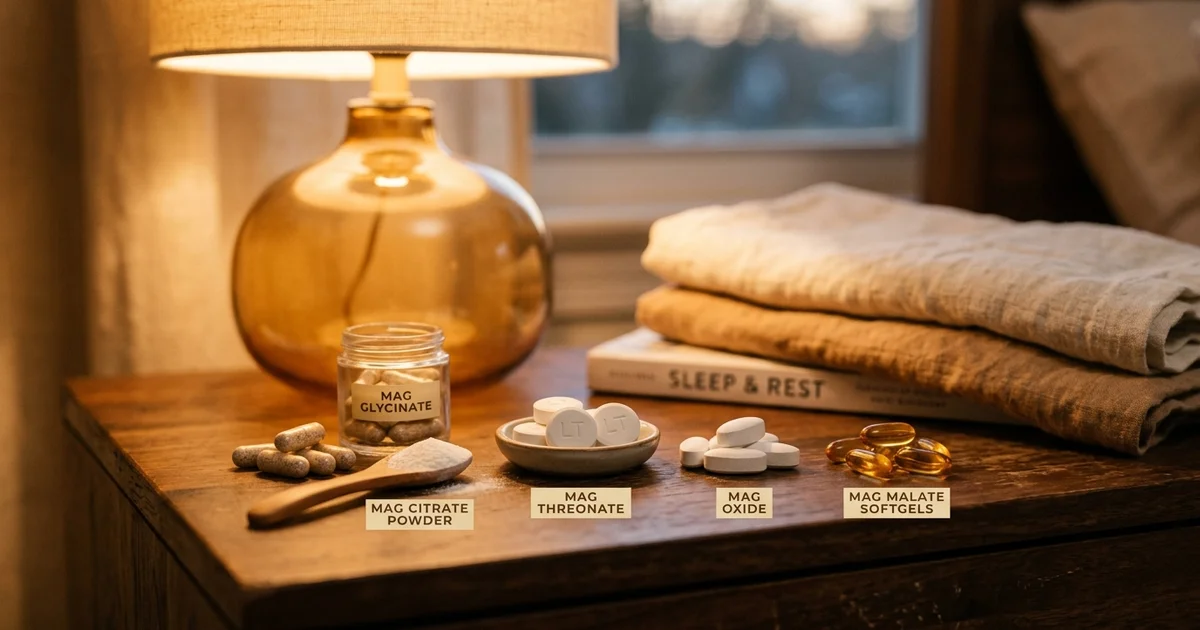
Which Is the Best Magnesium for Sleep? 6 Forms, Ranked by Science
There are at least a dozen forms of magnesium on the market. Most of them won't do much for your sleep. A few might actually make it worse (hello, 3 a.m. bathroom trips from magnesium citrate). So which is the best magnesium for sleep, and which forms are you better off skipping entirely?
The answer depends on what's actually keeping you up. Muscle tension, a racing mind, and stress-driven insomnia all respond to different magnesium forms. Understanding which is the best magnesium for sleep requires looking at absorption rates, clinical trials, and the specific mechanisms behind each form. Here's the breakdown, ranked by the current evidence.
Key Takeaways
- Magnesium glycinate is the strongest all-around pick for determining which is the best magnesium for sleep, backed by a 2025 randomized controlled trial showing improved insomnia scores in just four weeks.
- Magnesium L-threonate is the only form proven to cross the blood-brain barrier efficiently, making it the best option if racing thoughts keep you awake.
- Magnesium oxide, the cheapest and most common form, has an absorption rate as low as 4%. You're mostly paying for expensive urine.
- If you're wondering what is best magnesium for sleep and stress, the answer is glycinate, because its glycine component directly supports GABA activity and cortisol regulation.
How Magnesium Actually Affects Sleep
Before figuring out which is the best magnesium for sleep, it helps to understand the mechanism. Magnesium isn't a sedative. It works upstream of sleep by regulating two systems your brain needs to quiet down at night.
First, it binds to GABA receptors. GABA is the neurotransmitter responsible for slowing neural activity. According to research published in PMC, magnesium activates GABA pathways to reduce excitability in the central nervous system. Think of it as turning down the volume on your brain's chatter.
Second, magnesium helps regulate cortisol and the HPA (hypothalamic-pituitary-adrenal) axis, the system that controls your stress response. The same research notes that magnesium supplementation can decrease serum cortisol levels while supporting melatonin production. If you're lying in bed replaying every awkward thing you said in 2017, this is the pathway that's misfiring.
The problem? Nearly half of Americans consume less magnesium than the recommended daily amount. That gap between what you eat and what you need creates a baseline deficit that quietly erodes sleep quality over months and years. This widespread deficiency is exactly why so many people are asking which is the best magnesium for sleep in the first place.
The 6 Forms of Magnesium, Ranked for Sleep
1. Magnesium Glycinate (Bisglycinate): Best Overall for Sleep
If you're asking which magnesium best for sleep, this is the one most sleep researchers reach for first, and for good reason. Magnesium glycinate pairs elemental magnesium with glycine, an amino acid that has its own calming effects on the nervous system. You get a two-for-one deal: magnesium for GABA activation, plus glycine for additional nervous system support.
The clinical data is solid. A 2025 randomized, double-blind, placebo-controlled trial enrolled 155 adults with self-reported poor sleep and assigned them to either 250 mg of elemental magnesium (as bisglycinate) or placebo. After four weeks, the magnesium group showed a greater reduction in Insomnia Severity Index scores compared to placebo (−3.9 vs −2.3, p = 0.049).
If you're searching for the best magnesium glycinate powder for sleep, look for products that list "magnesium bisglycinate" or "magnesium glycinate chelate" on the label. These are the same compound. Avoid blends that mix in magnesium oxide as filler, because that dilutes the absorption. The best magnesium glycinate powder for sleep will contain no oxide fillers and clearly state the elemental magnesium content per serving.
Best for: General insomnia, difficulty falling asleep, muscle tension at night. Typical dose: 200-400 mg elemental magnesium, taken 30-60 minutes before bed.
2. Magnesium L-Threonate: Best for a Racing Mind
If your body is relaxed but your brain won't stop running, L-threonate is the form to consider. For anyone wondering which is the best magnesium for sleep when mental restlessness is the issue, L-threonate stands apart. It was developed at MIT specifically for its ability to cross the blood-brain barrier, something most magnesium forms do poorly.
A 2024 randomized controlled trial published in Sleep Medicine X tested magnesium L-threonate in 80 adults (ages 35-55) with self-reported sleep problems. The results showed improvements in sleep quality, with particular gains in deep sleep and REM sleep stages. Participants also reported better mood, energy, and daytime alertness.
A second trial published in Frontiers in Nutrition in 2025 confirmed these findings, linking magnesium L-threonate supplementation to improvements in both cognitive performance and sleep quality.
The tradeoff: L-threonate is more expensive than glycinate, and the dosing is higher (you typically need around 1,500-2,000 mg of the compound to get roughly 140 mg of elemental magnesium).
Best for: Mental restlessness, cognitive fog the morning after poor sleep. Typical dose: 1,500-2,000 mg magnesium L-threonate (about 140 mg elemental magnesium), taken in the evening.
3. Magnesium Taurate: Best for Sleep + Cardiovascular Support
Magnesium taurate combines magnesium with taurine, an amino acid with its own calming properties. According to a 2025 review in PMC, magnesium taurate is well-absorbed and the taurine component is known for its cardiovascular benefits.
This form doesn't have the same volume of sleep-specific clinical trials as glycinate or L-threonate. But if you're exploring what is best magnesium for sleep that also supports heart health, taurate is a reasonable choice.
Best for: People who want sleep support alongside cardiovascular benefits. Typical dose: 200-400 mg elemental magnesium before bed.
4. Magnesium Citrate: Decent Absorption, But Watch Your Gut
Magnesium citrate absorbs reasonably well (around 25-30%) and is widely available. The problem for sleep? It has a mild to moderate laxative effect. As noted by the Sleep Foundation, magnesium citrate has a milder laxative effect than oxide or chloride, but it can still cause GI disruption that wakes you up at night.
If you tolerate it fine, citrate works. But for most people specifically researching which is the best magnesium for sleep, glycinate is the better call.
Best for: General magnesium supplementation with some sleep benefit. Typical dose: 200-400 mg elemental magnesium.
5. Magnesium Malate: Better for Muscles Than Sleep
Magnesium malate is bound to malic acid, which plays a role in energy production and muscle recovery. HealthCentral notes that magnesium malate promotes muscle relaxation and may reduce tossing and turning caused by physical tension or soreness.
That said, because malic acid is involved in ATP (energy) production, some people find this form mildly energizing. Taking it before bed could backfire. It's a better fit for daytime supplementation or post-workout recovery, which is why it rarely comes up in discussions about which magnesium best for sleep.
Best for: Muscle soreness and recovery, daytime use. Typical dose: 200-400 mg elemental magnesium, taken earlier in the day.
6. Magnesium Oxide: Skip It for Sleep
Magnesium oxide is the cheapest form on the shelf, and there's a reason for that. According to research cited by Wholier, one study found magnesium oxide had a fractional absorption rate of just 4%, compared to 18.8% for magnesium glycinate. Most of it passes straight through your digestive system.
You'll find magnesium oxide in many budget supplements and "sleep blends." Check the label. If oxide is the primary form listed, you're getting very little usable magnesium. Anyone seriously asking which is the best magnesium for sleep should avoid oxide entirely.
Best for: Constipation relief (seriously, that's about it). Typical dose: Not recommended for sleep.
Quick Comparison: Which Magnesium Is Best for Sleep?
| Form | Absorption | Sleep Evidence | Best For | GI Side Effects |
|---|---|---|---|---|
| Glycinate | High | Strong (RCT, 2025) | Overall sleep quality | Minimal |
| L-Threonate | High (brain) | Strong (RCT, 2024) | Racing mind, deep sleep | Minimal |
| Taurate | Good | Moderate | Sleep + heart health | Low |
| Citrate | Moderate | Moderate | General supplementation | Moderate (laxative) |
| Malate | Good | Weak for sleep | Muscle recovery | Low |
| Oxide | Very low (~4%) | Weak | Constipation | High (GI distress) |
How to Choose the Right Form for You
Knowing which is the best magnesium for sleep depends on what's actually disrupting your rest. Here's how to match the form to your specific problem.
Your body won't relax. You feel physically tense, your legs are restless, or you're sore from training. Go with magnesium glycinate. The glycine provides direct nervous system calming while the magnesium works on muscle relaxation. If you prefer a powder format, finding the best magnesium glycinate powder for sleep lets you dial in your dose more precisely than capsules.
Your mind won't shut off. You're exhausted but mentally wired. Magnesium L-threonate is designed for this. It's the only form with strong evidence for increasing brain magnesium levels specifically.
You want general coverage. If you're not sure what's causing your sleep issues and just want to close the dietary gap, glycinate is still the safest starting point. For anyone asking what is best magnesium for sleep without a specific symptom to target, glycinate's broad evidence base makes it the clear winner.
You're on a budget. Magnesium citrate is a reasonable second choice if glycinate is out of your price range. Just start with a lower dose and see how your stomach handles it.
One thing every sleep researcher agrees on: whichever form you pick, take it 30-60 minutes before bed and stay consistent. Magnesium builds in your system over weeks. A single dose won't produce dramatic results overnight. Now that you know which is the best magnesium for sleep, consistency is what separates results from wishful thinking.
Sleep Is Half the Equation
Getting your magnesium dialed in is one of the highest-return moves you can make for sleep quality. Knowing which is the best magnesium for sleep, and actually taking it consistently, means sharper thinking, faster reaction times, and more consistent energy throughout the day.
But here's the thing: sleep quality sets the floor for cognitive performance. What you do during your waking hours determines the ceiling.
That's where Roon comes in. Roon is a zero-nicotine sublingual pouch built around a stack of Caffeine (40 mg), L-Theanine, Theacrine, and Methylliberine, designed to deliver 4-6 hours of sustained focus without jitters, crashes, or tolerance buildup. Good sleep hygiene for the night. Clean, sustained performance for the day.
Optimize your waking hours at takeroon.com.
READY TO UNLOCK YOUR FOCUS?
Subscribe for exclusive discounts and more content like this delivered to your inbox.