ATTENTION SPAN MEANING: WHAT SCIENCE ACTUALLY SAYS (AND WHY IT MATTERS MORE THAN YOU THINK)
Roon Team
Attention Span Meaning: What Science Actually Says (and Why It Matters More Than You Think)
You've probably heard the claim: humans now have a shorter attention span than a goldfish. Understanding attention span meaning starts with questioning that very statistic. Eight seconds for you, nine for the fish. It's a great headline. It's also not quite true.
The real story behind attention span meaning is more interesting, more useful, and more relevant to how you actually perform at work, in conversation, and during the hours when focus counts most. So let's get specific.
Key Takeaways
- To define attention span: it's the length of time you can concentrate on a task before your focus shifts to something else.
- The "goldfish" statistic is misleading. Attention span meaning can't be reduced to a single number. It varies by type, context, and individual.
- Research from UC Irvine shows the average time spent on a single screen before switching dropped to 47 seconds by 2016.
- Understanding the different types of attention helps you protect and improve the one that matters most: sustained attention.
Attention Span Meaning: The Real Definition
The Cambridge Dictionary defines attention span as "the period during which you can stay interested or listen carefully to something." That's a clean starting point, but it barely scratches the surface of attention span meaning.
Wikipedia's entry puts it more precisely: to define attention span is to describe the amount of time spent concentrating on a task before becoming distracted. The key word there is task. Attention isn't some abstract mental resource floating around your skull. It's always tied to something you're doing, reading, building, or solving.
And here's what most articles on attention span meaning miss: there isn't just one kind.
The Four Types of Attention
Cognitive scientists break attention into distinct categories, each with different demands on your brain:
| Type | What It Does | Example |
|---|---|---|
| Sustained attention | Holding focus on one task over time | Reading a long report, deep coding work |
| Selective attention | Filtering out distractions to focus on one input | Listening to a colleague in a noisy office |
| Alternating attention | Switching between tasks that require different thinking | Jumping between email and a spreadsheet |
| Divided attention | Processing multiple inputs at the same time | Driving while holding a conversation |
According to The Peak Performance Center, sustained and selective attention are both needed when you have to focus on one thing at a time, while alternating attention reflects your brain's mental flexibility.
When people try to define attention span, they almost always mean sustained attention: your ability to stay locked onto a single task without drifting. That's the one under siege.
The Goldfish Stat: Where It Came From and Why It's Wrong
In 2015, a widely cited Microsoft Canada report claimed the average human attention span had fallen from 12 seconds in 2000 to just 8 seconds. Goldfish, supposedly, clock in at 9.
The problem? As reported by Temple University's Advocacy and Evidence Resources, the underlying data came from a source called Statistics Brain, which based its claim on just two references. The goldfish figure has no clear scientific origin. As one analysis noted, "no one knows how to actually measure a goldfish's attention span."
The stat stuck because it felt true. Your phone buzzes, your mind wanders, and eight seconds sounds about right. But real attention research tells a different story about attention span meaning.
What the Science Actually Shows About Attention Span Meaning
Dr. Gloria Mark, a Professor of Informatics at UC Irvine, has spent nearly two decades tracking how people use screens. Her findings paint a more nuanced picture of attention span meaning than a single number ever could.
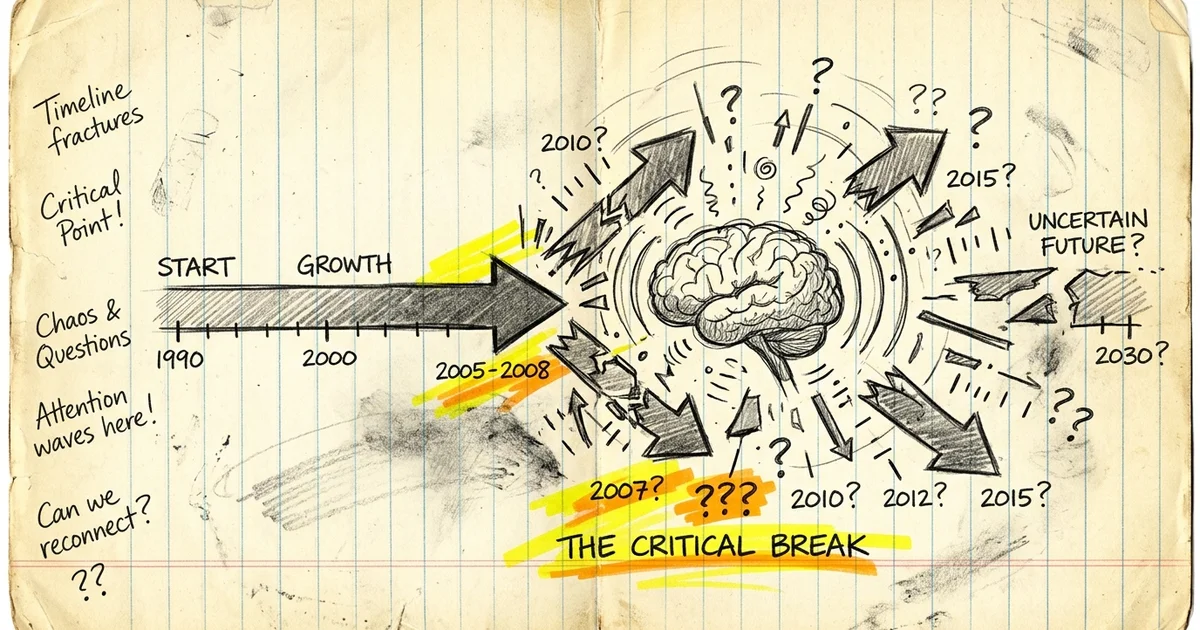
In a 2016 study, her team found that the average time a person spent on any single screen before switching was 47 seconds, with a median of 40 seconds. That's not 8 seconds, but it's still not great. And it was down from about 75 seconds in 2012.
As Mark explained in an interview with the APA, attention isn't a fixed trait. It fluctuates throughout the day, responds to stress, and follows rhythmic patterns. Some types of attention drain you like lifting heavy weights. Others restore you like rest between sets.
The takeaway: your attention span isn't broken. But it is shorter than it used to be, and the environment you operate in is actively working against it.
Why Is Attention Span Important?
This isn't an academic question. Understanding attention span meaning has practical stakes because the ability to sustain focus has direct, measurable effects on your performance.
At work: Every time you switch tasks, your brain pays a cognitive tax. It takes time to re-engage with the original task, and the quality of your thinking drops during the transition. If you're switching every 47 seconds, you're paying that tax hundreds of times a day. According to Amra and Elma, the average worker switches tasks roughly 566 times across an 8-hour workday.
In learning: Deep understanding requires sustained attention. You can't absorb complex material in 47-second bursts. This is why skimming articles feels productive but rarely leads to retention. So why is attention span important for students? Because without it, real comprehension never takes hold.
In relationships: Listening, real listening, requires selective and sustained attention working together. When your default mode is distraction, conversations get shallow fast. Why is attention span important here? Because presence is the foundation of connection.
The short version: attention is the bottleneck. Almost everything you care about doing well requires you to hold focus longer than your environment wants you to. That's the core of attention span meaning in everyday life.
What's Actually Happening in Your Brain
When you lose focus, it's not a character flaw. It's neurochemistry. Understanding attention span meaning at the biological level reveals three key systems at work.
Adenosine builds up in your brain throughout the day, binding to receptors that promote drowsiness and reduce alertness. This is the molecule behind that 2pm fog. Caffeine works by blocking adenosine receptors, which is why your morning coffee clears the haze.
Dopamine drives motivation and reward-seeking behavior. Every notification ping triggers a small dopamine hit, training your brain to chase interruptions instead of resisting them. Over time, this rewires your attention toward short, novel stimuli and away from sustained effort.
GABA, your brain's primary inhibitory neurotransmitter, helps regulate overexcitement and anxiety. When GABA signaling is off, your brain struggles to filter noise, making selective attention harder.
These three systems, adenosine, dopamine, and GABA, form the neurochemical foundation of your attention span. When they're out of balance, focus feels like pushing a boulder uphill.
How to Protect Your Attention Span
You can't control every notification or open-plan office distraction. But once you grasp attention span meaning at the biological level, you can influence the underlying systems.
1. Structure your environment. Close tabs. Silence your phone. Gloria Mark's research confirms that external interruptions account for roughly half of all attention shifts. The other half are self-interruptions, which means the environment you build matters for your attention span.
2. Work with your rhythm. Attention follows a natural arc. You have peak focus windows (usually mid-morning) and low points (early afternoon). Schedule deep work during peaks. Save email for the valleys.
3. Sleep. Adenosine clears during deep sleep. If you're chronically under-rested, you're starting every day with a neurochemical handicap that shortens your attention span before you even sit down.
4. Support the chemistry. The combination of L-theanine and caffeine has solid research behind it. A study published on PubMed found that 97mg of L-theanine combined with 40mg of caffeine helped participants focus attention during demanding cognitive tasks. L-theanine promotes calm alertness through GABA modulation, while caffeine handles the adenosine blockade. Together, they target two of the three systems that govern your ability to sustain focus.
Cut Through the Fog
If attention span meaning comes down to one thing, it's this: how long you can hold your mind on what matters before something pulls it away. That window is shrinking for almost everyone. But the fix isn't willpower. It's understanding the biology and working with it.
Roon was built around this exact principle. Its sublingual pouch delivers a nootropic stack of caffeine (40mg), L-theanine, theacrine, and methylliberine, four compounds that target the adenosine, GABA, and dopamine pathways behind brain fog and fractured focus. No nicotine. No jitters. No crash. Just 4 to 6 hours of sustained, clean attention.
Your attention span isn't a fixed number. It's a system you can support. Start here.
READY TO UNLOCK YOUR FOCUS?
Subscribe for exclusive discounts and more content like this delivered to your inbox.