MAGNESIUM GLYCINATE VS. CITRATE FOR SLEEP: A HEAD-TO-HEAD COMPARISON
Roon Team
Magnesium Glycinate vs. Citrate for Sleep: A Head-to-Head Comparison
You're standing in the supplement aisle, staring at two bottles of magnesium, and the only thing separating them is a word you can't pronounce. One says glycinate. The other says citrate. Both claim to help with sleep. So which one actually works, and which one is going to send you running to the bathroom at 2 a.m.? This is the magnesium glycinate vs citrate for sleep question that millions of supplement buyers get wrong every year.
The short answer: in the magnesium glycinate vs citrate for sleep debate, glycinate wins. But the full answer is more interesting, and it has everything to do with an amino acid called glycine.
Key Takeaways
- Magnesium glycinate is the stronger choice when comparing magnesium glycinate vs citrate for sleep because it pairs magnesium with glycine, an amino acid that independently promotes relaxation and lowers core body temperature.
- Magnesium citrate absorbs well but has a mild laxative effect that can disrupt sleep rather than support it.
- Both forms are better absorbed than magnesium oxide, the cheap form found in most drugstore supplements.
- If your real goal is sustained daytime focus (not just better sleep), the problem might not be magnesium at all.
Why the Magnesium Glycinate vs Citrate for Sleep Debate Matters
About half of all Americans don't get enough magnesium from their diet, according to Pharmacy Times. That's a problem for sleep because magnesium plays a direct role in calming the nervous system, and the form you choose determines how well it works at bedtime.
Here's the mechanism. Magnesium acts as both an NMDA receptor antagonist and a GABA receptor agonist, according to a review published in Dove Medical Press. In plain English: it blocks excitatory signals (the ones that keep your brain wired) while boosting inhibitory signals (the ones that tell your brain to wind down). That dual action is why magnesium deficiency is consistently linked to poor sleep architecture, restlessness, and trouble falling asleep. Understanding this mechanism is essential to evaluating magnesium glycinate vs citrate for sleep.
A meta-analysis on PubMed found that magnesium supplementation reduced sleep onset latency by an average of 17.36 minutes compared to placebo in older adults. That's not a trivial number. For someone who lies awake staring at the ceiling for 45 minutes, cutting a third of that time is meaningful.
Magnesium Glycinate: The Sleep Specialist
Magnesium glycinate is magnesium bonded to glycine, the smallest amino acid. This matters because glycine isn't just a delivery vehicle. It has its own sleep-promoting properties, which is the main reason magnesium glycinate vs citrate for sleep comparisons tend to favor glycinate.
The Glycine Advantage
Research on glycine and sleep is surprisingly strong. A study highlighted by the Sleep Foundation found that 3 grams of glycine taken before bedtime improved subjective sleep quality and reduced daytime fatigue. A separate investigation, covered by NutraIngredients, confirmed that glycine supplementation before bed improves sleep and decreases daytime fatigue in healthy populations.
The mechanism is elegant. Glycine lowers core body temperature by increasing blood flow to the extremities. Your body naturally drops its temperature to initiate sleep, so glycine accelerates a process that's already supposed to happen. According to a study in PMC, these sleep-promoting and hypothermic effects are mediated through NMDA receptors in the suprachiasmatic nucleus, the brain's master clock.
So when you take magnesium glycinate, you're getting a two-for-one: magnesium calms neural excitability while glycine cools the body and promotes deeper sleep. This dual mechanism is what makes magnesium glycinate or citrate for sleep an easy call for most people.
Absorption and Tolerability
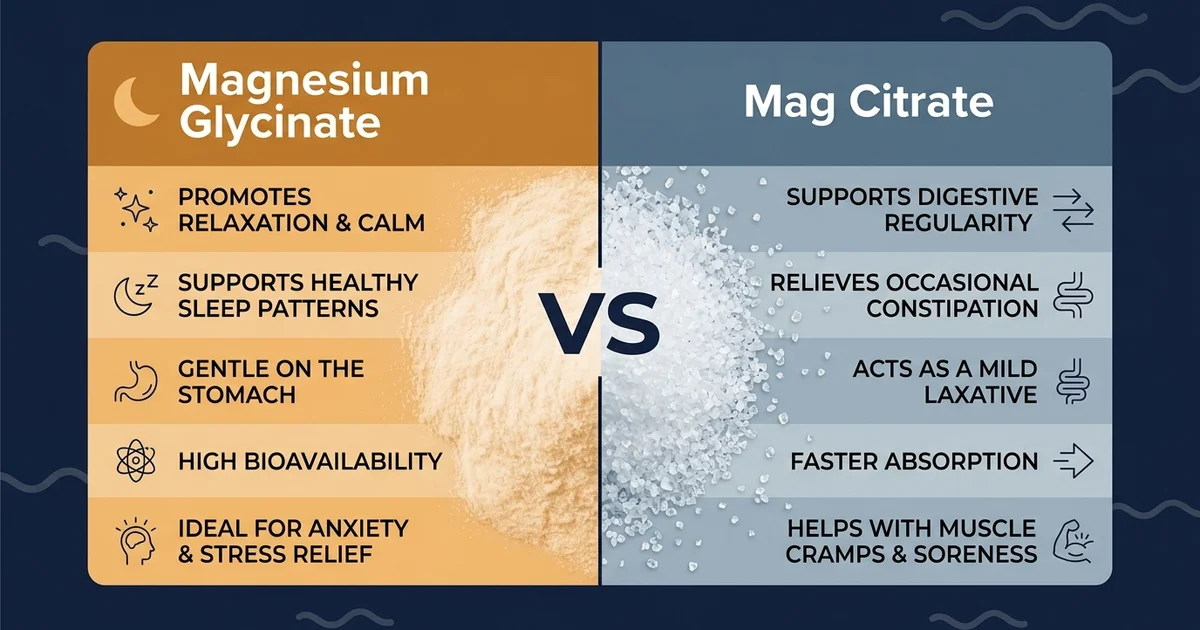
Magnesium glycinate also wins on gut comfort. According to BodyBio, the glycine component enhances transport across the intestinal wall, making it less likely to cause diarrhea or stomach upset. Mito Health reports that glycinate is gentler and often preferred for sleep, with bioavailability estimates around 90%+ despite a lower elemental magnesium dose per capsule. For anyone weighing magnesium citrate vs glycinate for sleep, tolerability alone can be the deciding factor.
Magnesium Citrate: Better for Your Gut Than Your Pillow
Magnesium citrate is magnesium bonded to citric acid. It absorbs reasonably well (around 60% bioavailability, per Mito Health's absorption guide), and it's one of the more affordable forms on the market.
But here's the catch.
The Laxative Problem
Magnesium citrate draws water into the intestines. That's the osmotic laxative effect, and it's the reason doctors prescribe high-dose magnesium citrate as bowel prep before colonoscopies. At supplement doses (200-400mg), the effect is milder, but it's still there. And for anyone comparing magnesium citrate vs glycinate for sleep, this GI difference is the detail that matters most at bedtime.
According to Cooper Complete, magnesium citrate has a mild, natural laxative effect and is often chosen by people who want digestive support alongside their magnesium intake. That's fine if constipation is your primary concern. It's less fine if you're trying to sleep through the night without a 3 a.m. bathroom trip.
Can Citrate Still Help Sleep?
Yes, to a degree. Any form of magnesium that raises your serum levels will support the GABA/NMDA mechanisms described above. Swiss Peak Health notes that many people find magnesium citrate works well enough for sleep, especially at moderate doses. But you're missing the glycine bonus, and you're adding a GI side effect that glycinate avoids. That's why most experts, when asked about magnesium citrate or glycinate for sleep, recommend glycinate.
Magnesium Glycinate vs. Citrate for Sleep: Side-by-Side
| Factor | Magnesium Glycinate | Magnesium Citrate |
|---|---|---|
| Best For | Sleep, relaxation, daily repletion | Digestive regularity, general supplementation |
| Bioavailability | ~90%+ | ~60% |
| GI Side Effects | Minimal | Mild laxative effect |
| Bonus Ingredient | Glycine (calming, lowers body temp) | Citric acid (no sleep benefit) |
| Cost | Moderate to high | Low to moderate |
| Sleep-Specific Evidence | Strong (magnesium + glycine data) | Moderate (magnesium data only) |
If you're choosing between magnesium citrate or glycinate for sleep specifically, glycinate is the clear pick. Citrate has its place, but that place is digestive health, not your nightstand. The magnesium glycinate vs citrate for sleep comparison really comes down to whether you want a compound that actively promotes sleep or one that merely supports baseline magnesium levels.
What About Magnesium Glycinate or Citrate for Sleep Combined With Other Ingredients?
Some people stack magnesium with other sleep-supporting compounds: melatonin, L-theanine, apigenin. That approach can work, but it introduces a different problem. You're now managing multiple supplements with different dosing windows, different half-lives, and different interactions. Whether you've settled on magnesium glycinate or citrate for sleep, the stacking question still applies.
Melatonin is the most common pairing, but it comes with trade-offs. Exogenous melatonin can suppress your body's own production over time, and many over-the-counter doses (5-10mg) are far higher than what research supports. If you go this route, stick to 0.5-1mg.
L-Theanine is worth calling out here. It's an amino acid found in tea that promotes alpha brain wave activity, the relaxed-but-alert state. It pairs well with magnesium for evening wind-down, but it's also one of the more effective compounds for daytime cognitive performance when combined with caffeine.
Which raises an honest question: is your real problem sleep, or is it the afternoon brain fog that makes you reach for a third coffee, which then wrecks your sleep, which makes the next day worse?
That cycle is more common than most people realize.
When the Problem Isn't Sleep. It's the Whole Day.
Settling the magnesium glycinate vs citrate for sleep question can help you fall asleep faster and sleep deeper. That's well-supported by the data.
But if you're reading this article because your focus crashes by 2 p.m. and you're self-medicating with caffeine or nicotine pouches just to get through the afternoon, a magnesium supplement at bedtime only addresses half the equation. Poor sleep feeds poor focus, and poor focus feeds poor sleep. Breaking that loop requires thinking about both ends of the clock. Choosing the right magnesium glycinate vs citrate for sleep is one piece; what you do during the day is the other.
Roon approaches the problem from the other end of the day. It's a zero-nicotine sublingual pouch built around a stack of Caffeine (40mg), L-Theanine, Theacrine, and Methylliberine, designed to deliver 4-6 hours of sustained focus without the jitters, crash, or tolerance buildup that comes with high-caffeine drinks or nicotine. No pills to swallow. No waiting 45 minutes for a capsule to dissolve.
Fix your nights with the right magnesium glycinate vs citrate for sleep choice. Fix your days with the right stack. See how Roon compares.
READY TO UNLOCK YOUR FOCUS?
Subscribe for exclusive discounts and more content like this delivered to your inbox.