DO BRAIN SUPPLEMENTS WORK? WHAT THE SCIENCE ACTUALLY SAYS
Roon Team
Do Brain Supplements Work? What the Science Actually Says
Americans spend billions on supplements for brain health every year. If you've ever asked yourself "do brain supplements work?", you're not alone. The global brain health supplement market hit an estimated $10.95 billion in 2024, and it's projected to more than double by 2030. That's a lot of money chasing a simple question with a complicated answer.
The honest answer to whether brain supplements work is more useful than a yes or a no. Some ingredients have strong clinical evidence behind them. Others are glorified pixie dust with a nice label. The difference comes down to what's in the bottle, how much of it is there, and whether the compounds actually reach your brain.
Key Takeaways:
- Most mass-market "brain supplements" contain ingredients with weak or no clinical evidence for cognitive performance.
- A small number of compounds, including caffeine, L-theanine, theacrine, and methylliberine, have peer-reviewed data supporting their effects on focus, attention, and alertness.
- Dosing matters as much as ingredient selection. Underdosed formulas won't produce results regardless of what's on the label.
- Stacking complementary compounds can produce effects that single ingredients can't match alone.
The Problem With Most Brain Supplements: Do Brain Supplements Work as Marketed?
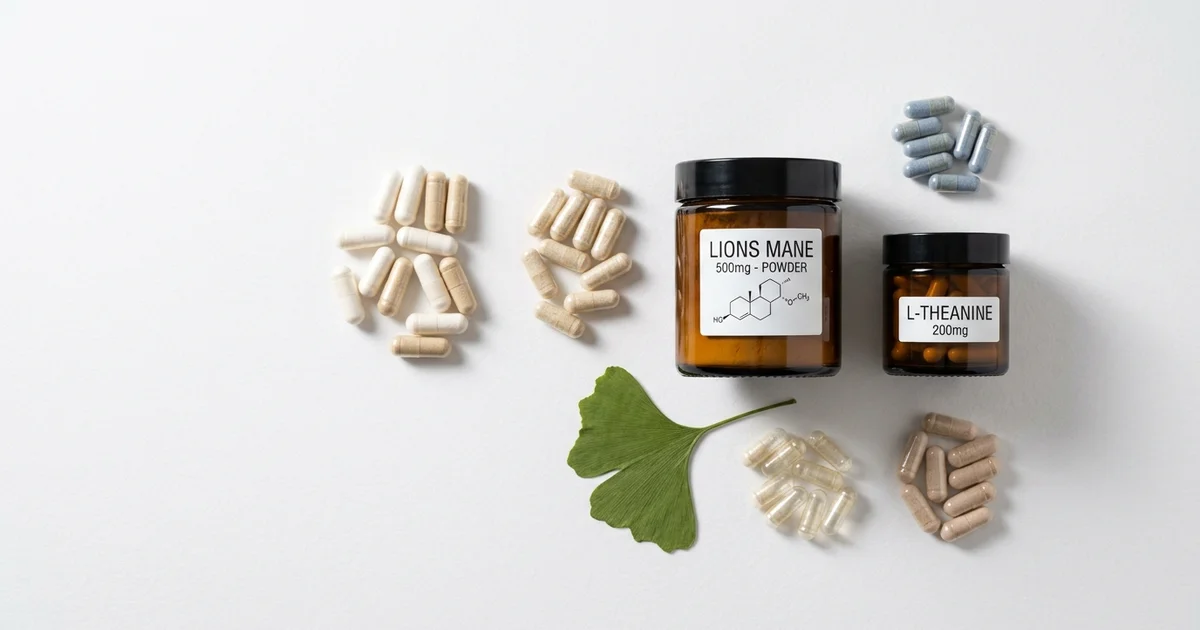
Walk into any supplement store and you'll find dozens of products promising sharper memory, better focus, and "cognitive optimization." The labels read like a neuroscience textbook: phosphatidylserine, ginkgo biloba, Bacopa monnieri, lion's mane mushroom.
Here's the issue. According to Cleveland Clinic, many of the ingredients tied to brain health in popular supplements draw their evidence from research on whole foods and diets, not isolated supplement forms. As their registered dietitian explains, food contains thousands of bioactive substances that work together to protect your brain. Pulling out one or two and putting them in a capsule doesn't guarantee the same result.
Harvard Health goes further, with Dr. Pieter Cohen, an internist whose research focuses on dietary supplements, stating there's no evidence that common brain supplement ingredients improve brain health in the way they're marketed. The problem isn't that every ingredient is useless. The problem is that most products use the wrong ingredients, at the wrong doses, with no consideration for how compounds interact. So do brain supplements work at all? The answer depends entirely on what's inside.
A 2020 analysis published in the Journal of Alzheimer's Disease reviewed 650 unique products marketed for brain health and cognitive performance. Of the 72 most frequently used ingredients, only 43% had been assessed through any type of systematic review. That means more than half the ingredients in supplements for brain health on shelves right now have barely been studied in a rigorous way.
The researchers also noted that manufacturers should be providing sound evidence before production, not after. The current system puts the burden on you, the consumer, to figure out which brain supplements work and which don't.
So Which Supplements for Brain Function Actually Have Evidence?
Not all healthy brain supplements are created equal. To truly answer whether brain supplements work, you need to look at the compounds with randomized, controlled trials showing measurable effects on human cognition. Here are the ones that clear that bar.
Caffeine
You already know this one works. Caffeine is the most widely consumed psychoactive substance on the planet, and its effects on alertness and reaction time are well-documented across hundreds of trials. But the dose matters more than most people realize.
Too much caffeine (above 300-400mg in a single dose) triggers anxiety, jitters, and a crash that wipes out any cognitive benefit. The sweet spot for sustained focus without side effects sits lower than you'd think, around 40-100mg per dose. For reference, a standard cup of coffee contains roughly 95mg. The best supplements for your brain use caffeine as a foundation, not a sledgehammer.
L-Theanine
L-theanine is an amino acid found naturally in tea leaves. On its own, it promotes a state of relaxed alertness. A randomized, placebo-controlled crossover study found that a single 200mg dose of L-theanine increased frontal alpha brain wave power, which is associated with calm, focused attention, not drowsiness.
But L-theanine's real value shows up when you pair it with caffeine, which is why it appears in so many healthy brain supplements.
The Caffeine + L-Theanine Stack
This is one of the most studied nootropic combinations in the literature, and it's a key reason why some brain supplements work while others fall flat. A study indexed on PubMed tested 97mg of L-theanine combined with 40mg of caffeine against a placebo in young adults. The combination improved accuracy during task switching and self-reported alertness (both p < 0.01) while reducing tiredness (p < 0.05).
A separate study available on ScienceDirect found that the caffeine-theanine combination improved target discriminability and hit rate during attention tasks, while L-theanine alone showed no effect on hit rate. The takeaway: L-theanine smooths out caffeine's rough edges while caffeine gives L-theanine the cognitive kick it lacks on its own.
This is why the best supplements for your brain tend to combine these two rather than use either in isolation.
Theacrine
Theacrine is a purine alkaloid structurally similar to caffeine, found in certain tea species. It acts on adenosine and dopamine pathways, supporting energy and focus. For anyone wondering do brain supplements work over the long term, theacrine offers an interesting answer.
What makes theacrine stand out is the tolerance question. Caffeine loses its punch over time as your body adapts. Theacrine doesn't seem to. An 8-week study published in the Journal of the International Society of Sports Nutrition found no evidence of habituation at doses up to 300mg per day. Baseline values for energy, focus, concentration, and motivation remained stable across the entire study period.
A 2025 study published in the Journal of the International Society of Sports Nutrition found that combining caffeine with theacrine improved cognitive performance before and after fatiguing exercise, with the combination showing benefits beyond high-dose caffeine alone. The researchers concluded that combining lower-dose caffeine with theacrine may match or exceed the cognitive effects of higher caffeine doses, with fewer side effects.
Methylliberine
Methylliberine (branded as Dynamine) is another purine alkaloid in the same family as caffeine and theacrine. A double-blind crossover trial found that methylliberine supplementation improved multiple indices of affect and well-being, including energy, focus, and motivation.
Where methylliberine gets particularly interesting is in combination with the other compounds. A randomized crossover study on male esports players tested a combination of caffeine, theacrine, and methylliberine against caffeine alone and placebo. The triple combination improved performance on the Flanker Test of Inhibitory Control and improved reaction time on the Psychomotor Vigilance Task, without increasing anxiety. This kind of data is what separates real supplements for brain performance from empty marketing.
Why Stacking Matters More Than Single Ingredients
The pattern in the research is clear. Individual nootropic compounds produce modest effects. Combinations produce stronger ones. This is central to understanding whether brain supplements work: the formula matters as much as the ingredients.
This isn't surprising if you think about how cognition actually works. Focus isn't a single neurochemical event. It involves dopamine for motivation, acetylcholine for attention, GABA for filtering distractions, and adenosine regulation for sustained wakefulness. No single molecule covers all of those pathways.
That's why the "mega-dose one ingredient" approach fails so often. You're flooding one receptor system while ignoring the others. A well-designed stack hits multiple targets at moderate doses, producing a cleaner, more balanced cognitive effect than any single compound at a high dose. The best supplements for your brain reflect this principle.
| Compound | Primary Mechanism | What It Does | Works Best With |
|---|---|---|---|
| Caffeine (40mg) | Adenosine antagonist | Increases alertness, reaction time | L-Theanine |
| L-Theanine | Increases alpha waves, modulates GABA | Promotes calm focus, reduces jitter | Caffeine |
| Theacrine | Adenosine + dopamine modulation | Sustained energy without tolerance buildup | Caffeine |
| Methylliberine | Dopamine modulation | Fast-acting mood and energy support | Caffeine, Theacrine |
Healthy brain supplements use this principle deliberately. They select compounds that cover different mechanisms and dose them based on clinical data, not marketing copy.
What to Look for (and What to Avoid)
If you're evaluating whether brain supplements work for your specific needs, run them through these filters:
- Are the active ingredients listed with exact doses? Proprietary blends that hide individual amounts are a red flag. You can't verify the dose if you can't see it.
- Do the ingredients have human clinical trials? Animal studies and in-vitro research don't translate reliably to your brain. Look for randomized, controlled trials in humans.
- Is the dose clinically relevant? An ingredient can have strong evidence at 200mg and do nothing at 20mg. Check whether the product matches the doses used in research.
- Does the delivery method make sense? Your body absorbs compounds differently depending on how you take them. Sublingual delivery (under the tongue) bypasses the digestive system and reaches your bloodstream faster than capsules that have to survive stomach acid first.
Avoid products that lean on trendy ingredients with thin evidence, massive proprietary blends, or claims that sound too good to be true. If a supplement promises to "boost IQ by 30 points," close the tab. Knowing which supplements for brain performance have real evidence is the first step to not wasting your money.
Also consider format. A capsule that takes 45 minutes to break down in your stomach delivers a very different experience than a sublingual format that absorbs through the tissue under your tongue. Speed and bioavailability aren't marketing buzzwords. They determine whether you feel anything at all.
Do Brain Supplements Work? The Bottom Line
The brain supplement market is full of noise. Most products don't work because they're built on hype rather than pharmacology. But a small subset of compounds, specifically caffeine, L-theanine, theacrine, and methylliberine, have real, peer-reviewed evidence showing they support focus, alertness, and cognitive performance when dosed correctly and combined intentionally.
So do brain supplements work? The science isn't ambiguous here. The right compounds, at the right doses, do work. The question is whether the product you're looking at actually contains them in the right amounts and the right format. That's the difference between healthy brain supplements backed by data and expensive placebos collecting dust on your shelf.
The Nootropic Stack, Simplified
Roon puts all four of these evidence-backed compounds into a single sublingual pouch: 40mg caffeine, L-theanine, theacrine, and methylliberine. No nicotine. No guesswork. Just the doses that match the research, delivered under the tongue for faster absorption.
If you've been sorting through supplements trying to build your own stack, this is the part where you stop. Try Roon and see what a properly built nootropic actually feels like.
READY TO UNLOCK YOUR FOCUS?
Subscribe for exclusive discounts and more content like this delivered to your inbox.