NOOTROPIC POUCHES VS. NOOTROPIC CAPSULES: WHICH FORMAT ACTUALLY DELIVERS FASTER?
Roon Team
Nootropic Pouches vs. Nootropic Capsules: Which Format Actually Delivers Faster?
The debate over nootropic pouches vs capsules starts the moment you sit down to work. The deadline is real, the brain fog is realer, and you're staring at a bottle of capsules wondering how long until they kick in. Thirty minutes? An hour? The answer depends less on what's in your nootropic and more on how it gets into your bloodstream. The nootropic pouches vs capsules question isn't about branding or convenience. It's about pharmacokinetics, the literal science of how fast a compound moves from point A (your mouth or stomach) to point B (your brain).
This comparison breaks down the two dominant nootropic delivery format options, covers the biggest capsule brands (Alpha Brain, Gorilla Mind Smooth, Mind Lab Pro, Thesis) alongside the growing sublingual pouch category (Mojo, Nectr, FlowBlend), and explains why the fastest nootropic isn't always the one with the longest ingredient list.
Key Takeaways:
- Sublingual absorption nootropics bypass the digestive system and can reach the bloodstream in as little as 10-15 minutes, while capsules typically take 30-60 minutes.
- Capsule-based nootropics lose a portion of their active ingredients to stomach acid and first-pass liver metabolism.
- Most nootropic pouches on the market use simple, caffeine-forward formulas without a full cognitive stack.
- The ideal nootropic delivery format combines sublingual speed with a multi-compound nootropic formula.
How Sublingual Absorption Actually Works (And Why Nootropic Pouches vs Capsules Matters)
The tissue under your tongue is thin, highly vascularized, and sits millimeters away from your bloodstream. When a compound dissolves there, it passes directly through the oral mucosa and into systemic circulation. No stomach. No liver. No waiting. This is the core reason the nootropic pouches vs capsules distinction exists in the first place.
This matters because of something called first-pass metabolism. According to the National Library of Medicine, the first-pass effect is a pharmacological phenomenon where a drug undergoes metabolism before reaching systemic circulation, primarily in the liver. For oral capsules, this means a meaningful percentage of the active compound gets broken down before it ever reaches your brain.
Sublingual absorption nootropics sidestep this entirely. A research paper on sublingual drug delivery found that peak blood levels of most sublingually administered products are achieved within 10-15 minutes. Compare that to oral capsules, which typically require 30-60 minutes just to begin dissolving in the stomach, followed by intestinal absorption and hepatic processing.
Wikipedia's overview of sublingual administration notes that the route ensures a substance will only risk degradation by salivary enzymes before entering the bloodstream, whereas orally administered drugs must survive the hostile environment of the gastrointestinal tract.
The speed difference isn't subtle. It's the difference between feeling sharper before your morning meeting starts and feeling sharper after it ends. This is why nootropic pouches vs capsules is a question worth taking seriously.
For nootropics specifically, sublingual absorption nootropics matter more than most people realize. Many popular nootropic compounds, including B vitamins and certain amino acids, are partially degraded by gastric acid. Sublingual delivery protects them from that environment entirely.
Nootropic Pouches vs Capsules: The Delivery Format Breakdown
Here's where the two formats diverge on the metrics that actually matter to someone trying to get focused, fast.
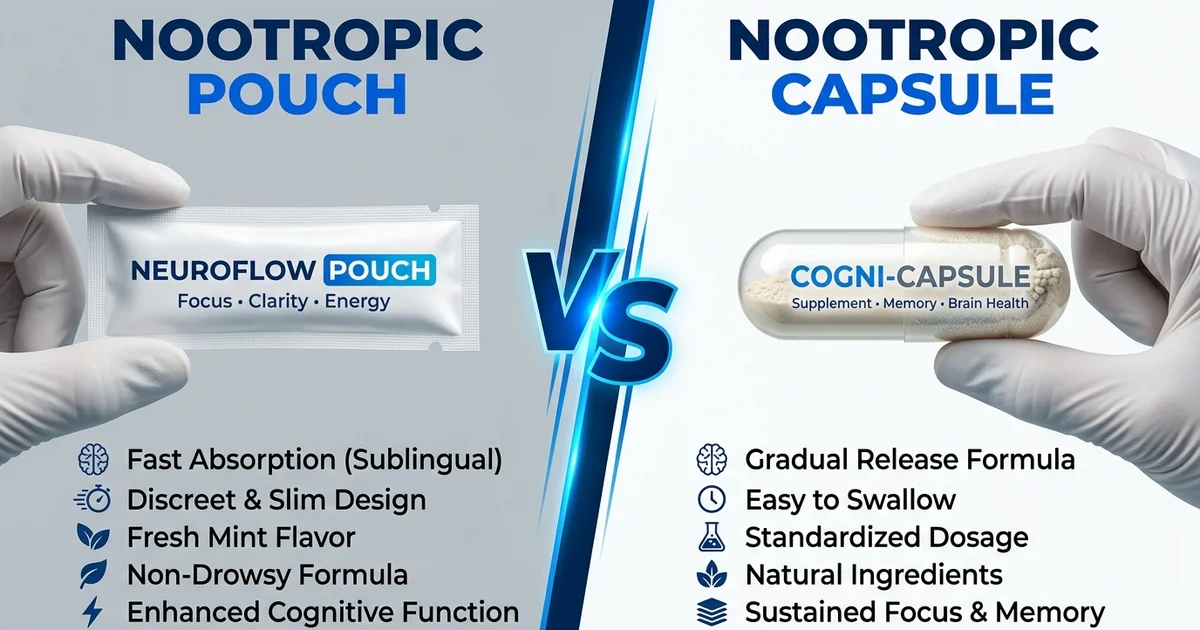
| Factor | Sublingual Pouches | Oral Capsules |
|---|---|---|
| Onset Time | ~10-15 minutes | ~30-60 minutes |
| First-Pass Metabolism | Bypassed | Full exposure |
| Bioavailability | Higher (direct to bloodstream) | Lower (degraded by stomach acid and liver) |
| Water Required | No | Usually yes |
| Portability | Pocket-sized, discreet | Bottle, blister pack |
| Dosing Precision | Fixed per pouch | Fixed per capsule (but proprietary blends obscure amounts) |
| Typical Ingredient Count | 2-4 compounds | 6-12+ compounds |
| Taste | Flavored | None (encapsulated) |
The trade-off in the nootropic pouches vs capsules comparison is clear. Capsules can pack more ingredients per serving, but they deliver them slowly and with losses along the way. Pouches deliver fewer compounds, but they deliver them fast and intact.
The question is whether that speed advantage holds up when you compare specific products head to head. Anyone searching for the fastest nootropic needs to look beyond ingredient lists and examine the nootropic delivery format itself.
The Capsule Contenders: Alpha Brain, Gorilla Mind, Mind Lab Pro, and Thesis
Alpha Brain (Onnit)
Alpha Brain is probably the most recognized nootropic capsule on the market, largely thanks to Joe Rogan's long-running endorsement. The formula uses three proprietary blends: the Onnit Flow Blend, the Onnit Focus Blend, and the Onnit Fuel Blend. In any Alpha Brain vs pouches comparison, the nootropic delivery format is the first thing to examine.
According to Innerbody's detailed review, the Onnit Flow Blend contains 650mg total of L-tyrosine, L-theanine, oat straw extract, and phosphatidylserine. The problem? Those are four ingredients sharing 650mg, and you have no idea how much of each you're getting. As Fortune Recommends noted, the use of proprietary blends makes it difficult to assess the effectiveness of individual ingredients.
Alpha Brain contains no caffeine, which is a deliberate choice. For some users, that's a feature. For others, it means stacking it with coffee anyway, which defeats the purpose of a controlled-dose formula. The Alpha Brain vs pouches debate often comes down to this: capsules offer more ingredients, but sublingual pouches offer faster onset.
Price: Roughly $35 for 30 capsules (a 15-day supply at the recommended 2-capsule dose), or about $2.33 per serving.
Gorilla Mind Smooth
Gorilla Mind Smooth takes the opposite approach to transparency. Every ingredient dose is listed on the label: Alpha-GPC, ALCAR (Acetyl-L-Carnitine), Uridine Monophosphate, Ginkgo Extract, Bacopa Monnieri, L-Theanine, Saffron Extract, and Huperzine A. According to Gorilla Mind's product page, the formula is designed for cognitive function and mental performance without heavy stimulation.
Like Alpha Brain, it's caffeine-free. The ingredient list is solid on paper, with clinically relevant compounds for memory and focus. But it's still a capsule. You're still waiting 30-60 minutes for those ingredients to clear your digestive system. In the nootropic pouches vs capsules equation, that delay is a real cost.
Price: Approximately $39.99 for 90 capsules (a 30-day supply at 3 capsules per day), or about $1.33 per serving.
Mind Lab Pro
Mind Lab Pro positions itself as a "universal nootropic" with 11 ingredients, all at disclosed doses. The formula includes Citicoline (as Cognizin), Bacopa Monnieri, Lion's Mane Mushroom, Phosphatidylserine, N-Acetyl L-Tyrosine, L-Theanine, Rhodiola Rosea, and Vitamins B6, B9, and B12, according to Mind Lab Pro's ingredients page.
It's arguably the most complete capsule formula on this list. No proprietary blends, no caffeine, no filler. The downside is the same as every other capsule: oral delivery, first-pass metabolism, and a 30-60 minute wait before you feel anything. For anyone weighing nootropic pouches vs capsules, Mind Lab Pro represents the best-case scenario for capsules and still falls short on speed.
Price: Around $69.99 for 60 capsules (a 30-day supply), or about $2.33 per serving.
Thesis
Thesis takes a personalized approach. You fill out a quiz, and they send you four different blends to try (Clarity, Creativity, Motivation, Energy, and others). According to Hone Health's review, Thesis costs $79 a month, or $3.29 per serving, once you've set up automatic renewal.
The personalization angle is interesting, but as Revgear's review pointed out, the blends themselves cannot be customized per individual. You're choosing from pre-made formulas, not building your own. And every blend is still delivered via capsule, with the same absorption limitations that apply to every other product in this category.
Price: $79/month for 24 packets, or about $3.29 per serving.
Capsule Comparison Table
| Product | Key Ingredients | Caffeine | Transparent Dosing | Price/Serving |
|---|---|---|---|---|
| Alpha Brain | L-Theanine, Alpha-GPC, Bacopa, Huperzia Serrata | No | No (proprietary blends) | ~$2.33 |
| Gorilla Mind Smooth | Alpha-GPC, ALCAR, Bacopa, L-Theanine, Saffron | No | Yes | ~$1.33 |
| Mind Lab Pro | Citicoline, Lion's Mane, Bacopa, L-Theanine, Rhodiola | No | Yes | ~$2.33 |
| Thesis | Varies by blend (personalized) | Some blends | Yes | ~$3.29 |
The Pouch Players: Mojo, Nectr, and FlowBlend
The nootropic pouch category is newer and smaller, but it's growing fast. Here's what the main players offer, and how they stack up in the nootropic pouches vs capsules conversation.
Mojo
According to Cyclone Pods' roundup of nootropic pouches, Mojo delivers 50mg of naturally derived caffeine from green tea, with effects kicking in after around 20 minutes. The formula also includes adaptogens like Yerba Mate, Asian and Siberian Ginseng, Rhodiola, B vitamins, and amino acids, per Tobacco Insider's overview.
Mojo leans heavily into the "balanced energy" angle. It's a solid caffeine pouch with some adaptogenic support, but it's not a full nootropic stack designed for sustained cognitive performance.
Nectr
Nectr takes a more targeted approach. According to Tobacco Insider, each pouch contains 30mg caffeine and 62.5mg Citicoline (marketed as Cognizin). That's a smarter formula than most energy pouches, since Citicoline has actual clinical evidence for supporting attention and focus.
But 30mg of caffeine is less than half a cup of coffee, and two ingredients, however well-chosen, don't constitute a full cognitive performance stack. You get speed of delivery without depth of formula. In the nootropic pouches vs capsules matchup, Nectr wins on absorption but loses on formula depth.
FlowBlend
FlowBlend markets itself as a nootropic pouch for focus and mental clarity. According to FlowBlend's site, their pouches use targeted ingredients and sublingual absorption nootropics technology to deliver steady cognitive support. The brand positions itself against energy drinks and pills, emphasizing the sublingual advantage.
Pouch Comparison Table
| Product | Caffeine | Notable Ingredients | Approach |
|---|---|---|---|
| Mojo | 50mg (green tea) | Adaptogens, B vitamins, amino acids | Balanced energy |
| Nectr | 30mg | Citicoline (Cognizin) | Targeted focus |
| FlowBlend | Varies | Various nootropics | Mental clarity |
What's Missing: The Gap in Nootropic Pouches vs Capsules
After looking at both categories side by side, a pattern emerges.
Capsules have the ingredients but not the speed. Alpha Brain, Gorilla Mind Smooth, Mind Lab Pro, and Thesis all contain well-researched nootropic compounds. But every single one of them forces those compounds through your digestive tract, where stomach acid degrades a portion and first-pass liver metabolism strips away more. You're paying for 100% of the dose and absorbing less. And you're waiting half an hour to an hour before anything happens. In any Alpha Brain vs pouches comparison, this absorption gap is the defining difference.
Pouches have the speed but not the stack. Mojo, Nectr, and FlowBlend all use sublingual delivery, which gets compounds into your bloodstream in roughly 10-15 minutes. That's a real advantage for anyone seeking the fastest nootropic option. But most pouch formulas are built around caffeine plus one or two supporting ingredients. They're energy products with a nootropic label, not full cognitive performance formulas.
There are three specific gaps no product in either nootropic delivery format fully addresses:
-
No sustained-release energy architecture. Caffeine alone spikes and crashes. The capsule brands solve this by removing caffeine entirely, which eliminates the crash but also eliminates the acute focus boost most people need. The pouch brands include caffeine but don't pair it with compounds designed to extend and smooth the energy curve.
-
No tolerance management. Regular caffeine use builds tolerance, sometimes within a week of daily consumption. None of the pouch brands include methylxanthine relatives like theacrine or methylliberine, compounds structurally similar to caffeine that activate the same adenosine receptors without the same tolerance buildup. And none of the capsule brands address this either, since most of them skip caffeine altogether rather than solving the tolerance problem.
-
No pouch combines sublingual speed with a multi-compound nootropic formula. The capsule brands prove that stacking complementary compounds (L-Theanine for calm focus, cholinergics for memory, adaptogens for stress resilience) works better than any single ingredient. But no pouch brand has translated that stacking philosophy into the sublingual format. This is the central tension in the nootropic pouches vs capsules debate.
The ideal nootropic delivery format would combine the absorption speed of sublingual absorption nootropics with a formula designed for sustained, crash-free cognitive performance, one that addresses tolerance buildup and pairs caffeine with compounds that extend its benefits without amplifying its downsides.
The Fastest Nootropic: The Fastest Path to Focus
This is the exact problem Roon was built to solve, and why the nootropic pouches vs capsules debate finally has a clear answer.
Roon is a zero-nicotine sublingual pouch containing four active compounds: Caffeine (40mg), L-Theanine, Theacrine, and Methylliberine. It's not a caffeine pouch with a nootropic label. It's a full methylxanthine nootropic stack in a sublingual format.
Here's how each ingredient addresses the gaps identified above:
- Caffeine (40mg) provides the acute focus boost, dosed low enough to avoid jitters but high enough to be effective.
- L-Theanine promotes calm, focused attention and smooths out caffeine's stimulatory edge, a pairing backed by extensive research.
- Theacrine is a purine alkaloid structurally related to caffeine that supports energy and motivation without the tolerance buildup associated with caffeine alone.
- Methylliberine is another methylxanthine that complements theacrine's effects, helping to extend the duration of focus to 4-6 hours without a crash.
Because Roon uses sublingual absorption, the stack bypasses first-pass metabolism and reaches your bloodstream in minutes, not the 30-60 minutes you'd wait with any capsule on this list. That makes it the fastest nootropic option that also delivers a complete cognitive stack.
Roon doesn't try to be a 12-ingredient kitchen-sink formula. It's four compounds, chosen specifically to work together, delivered through the fastest absorption route available. No water needed. No bottle to carry. No waiting. For anyone still weighing nootropic pouches vs capsules, Roon represents the best of both worlds: sublingual speed with a purpose-built formula.
If you've been choosing between capsules that take too long and pouches that don't do enough, Roon closes that gap. It's the fastest path to focus.
READY TO UNLOCK YOUR FOCUS?
Subscribe for exclusive discounts and more content like this delivered to your inbox.