CAFFEINE POUCHES VS NOOTROPIC POUCHES: WHAT ACTUALLY SEPARATES THEM?
Roon Team
Caffeine Pouches vs Nootropic Pouches: What Actually Separates Them?
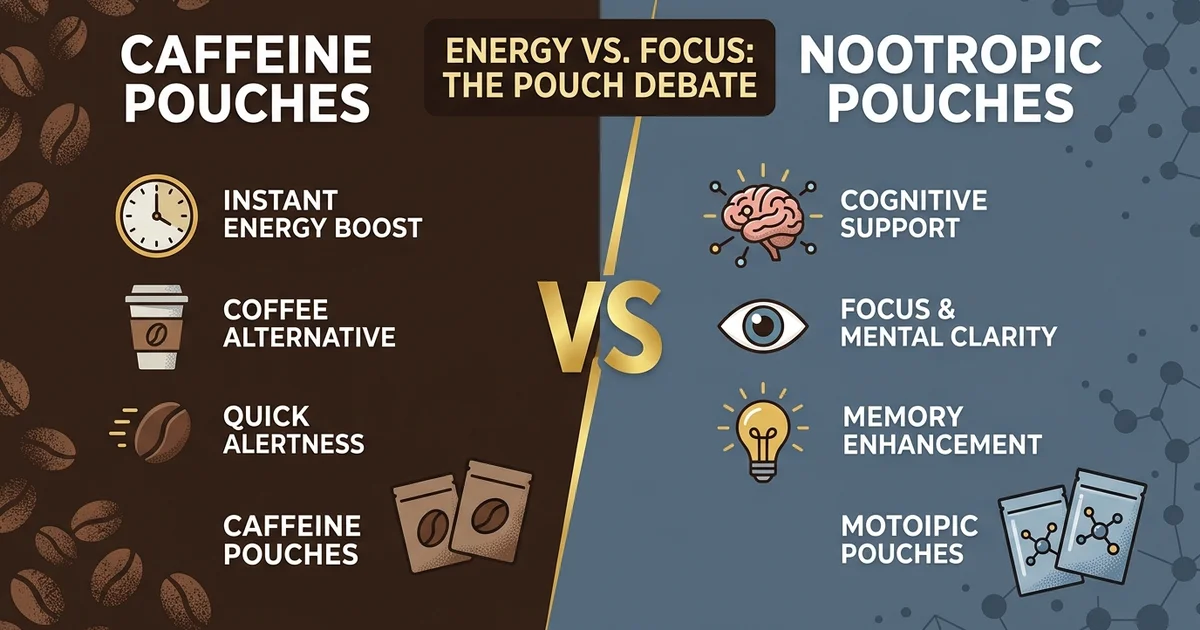
The oral pouch market has split into two camps, and if you've been shopping for a nicotine-free option, you've probably noticed the divide. On one side: caffeine pouches. On the other: nootropic pouches. The labels look similar. The cans sit next to each other on the shelf. But the difference between caffeine pouches vs nootropic pouches is more than branding. It comes down to what's inside, how it works in your brain, and how long the effect actually lasts.
This guide breaks down the real nootropic pouches difference, compares specific products head-to-head (including Wip vs Ultra and others), and helps you figure out which type of focus pouches matches what you're actually trying to accomplish.
Key Takeaways:
- Caffeine pouches deliver stimulation through a single compound (caffeine), similar to an energy drink in pouch form.
- Nootropic pouches combine caffeine (or skip it entirely) with cognitive compounds like L-Theanine, Alpha GPC, or citicoline.
- The best results come from stacking multiple compounds that work on different pathways, not just increasing caffeine dose.
- Duration, crash potential, and tolerance buildup vary widely between energy pouches and focus pouches.
What Are Caffeine Pouches?
Caffeine pouches are exactly what they sound like: small, sublingual or buccal pouches that deliver caffeine through the lining of your mouth. Think of them as energy pouches minus the liquid, sugar, and carbonation.
The category includes brands like Wip, Grinds, and Smokey Mountain Energy. Their formulas lean heavily on caffeine as the primary active ingredient, sometimes paired with B vitamins or taurine for support.
The Big Three Caffeine Pouch Brands
Wip is one of the more visible players. Their caffeine pouches contain 100mg to 200mg of natural caffeine from green coffee beans, along with B vitamins (Niacin, B6, B12) and chromium. That's a straightforward energy formula. The 200mg option packs roughly the same caffeine as two cups of coffee in a single pouch.
Grinds started as a coffee pouch brand for baseball players looking to ditch chewing tobacco. Their pouches contain actual ground coffee and chicory, plus an energy blend of caffeine (25-100mg), taurine, glucuronolactone, and B vitamins. It's an energy drink ingredient list stuffed into a pouch.
Smokey Mountain Energy follows a similar playbook: caffeine, B vitamins, and not much else in the cognitive department.
The pattern is clear. These energy pouches solve one problem: delivering caffeine without a can, bottle, or cup. They do that well. But caffeine is the only tool in the box.
What Are Nootropic Pouches?
Nootropic pouches (sometimes called focus pouches) take a different approach. Instead of relying on caffeine alone, they include compounds designed to support focus, memory, or mental clarity through multiple neurochemical pathways.
The term "nootropic" refers to any substance that supports cognitive function. Some are stimulants. Many aren't. The defining feature of a nootropic pouch is that it contains at least one ingredient targeting cognition beyond simple stimulation.
The Leading Nootropic Pouch Brands
Ultra positions itself as a caffeine-free nootropic pouch. Its formula includes enfinity (paraxanthine), L-Theanine, Panax Ginseng, and Alpha GPC, along with B vitamins. Paraxanthine is a metabolite of caffeine that provides alertness without the same jitteriness. The caffeine-free angle is their main differentiator in the Wip vs Ultra comparison.
Mojo takes a broader approach. Their focus pouches contain 50mg of caffeine from arabica coffee, L-Theanine, N-Acetyl-L-Tyrosine, Panax Ginseng, Yerba Mate, Eleuthero Root, and Rhodiola. That's a longer ingredient list than most caffeine pouches, blending adaptogens with a moderate caffeine dose.
Nectr uses 30mg of natural caffeine paired with 62.5mg of Cognizin Citicoline and L-Theanine in a 2:1 ratio with caffeine. Born in Sweden, Nectr leans into the citicoline angle, which supports acetylcholine production and has clinical data behind it for sustained attention.
Caffeine Pouches vs Nootropic Pouches: The Comparison Table
Here's how the two categories stack up across the metrics that actually matter:
| Feature | Caffeine Pouches (Wip, Grinds) | Nootropic Pouches (Ultra, Mojo, Nectr) |
|---|---|---|
| Primary Active | Caffeine (25-200mg) | Caffeine (0-50mg) + cognitive compounds |
| Supporting Ingredients | B vitamins, taurine | L-Theanine, Alpha GPC, citicoline, adaptogens |
| Mechanism | Adenosine receptor blocking | Multiple pathways (cholinergic, dopaminergic, GABAergic) |
| Onset | Fast (5-10 min) | Fast to moderate (5-15 min) |
| Duration | 1-3 hours | 3-6 hours (varies by formula) |
| Crash Potential | Moderate to high (dose-dependent) | Low to moderate |
| Tolerance Buildup | Yes (caffeine tolerance is well-documented) | Depends on ingredients |
| Best For | Quick energy boost | Sustained focus and cognitive performance |
The table tells a simple story. When comparing caffeine pouches vs nootropic pouches, the former are blunt instruments. They hit hard and fade fast. Nootropic pouches try to be more precise, targeting the quality of your attention rather than just the quantity of your energy.
How Caffeine Pouches Work (and Where They Fall Short)
Caffeine blocks adenosine receptors in your brain. Adenosine is the compound that accumulates throughout the day and makes you feel sleepy. Block it, and you feel more alert. Simple.
The problem is that caffeine does this one thing and nothing else. It doesn't improve the quality of your focus. It doesn't support working memory. It doesn't help you stay on task when the task is boring. Caffeine pouches just prevent you from feeling tired.
And the higher the dose, the more side effects you invite. A 200mg pouch will spike your cortisol, potentially increase anxiety, and almost certainly produce a crash 2-3 hours later when the adenosine floods back in. Your body also builds tolerance to caffeine within 1-2 weeks of daily use, which means you need more to get the same effect. That's a treadmill.
How Nootropic Pouches Change the Equation
The science behind nootropic pouches is about stacking: combining compounds that work on different brain systems so the total effect is greater than any single ingredient.
The most well-studied example is the caffeine + L-Theanine combination. A study published in Nutritional Neuroscience found that 40mg of caffeine combined with 97mg of L-Theanine improved focus during demanding cognitive tasks better than either compound alone. L-Theanine, an amino acid found in tea leaves, promotes alpha brain wave activity, which is associated with calm, attentive focus. It smooths out caffeine's rough edges without dulling the alertness.
Other nootropic ingredients work through entirely different systems:
- Alpha GPC and Citicoline support acetylcholine production, the neurotransmitter most directly tied to memory and learning.
- N-Acetyl-L-Tyrosine is a precursor to dopamine and norepinephrine, which regulate motivation and attention under stress.
- Adaptogens like Rhodiola and Ginseng modulate the stress response, helping maintain cognitive performance when you're under pressure.
The key nootropic pouches difference: these compounds don't just add energy. They shape the type of mental state you're in.
What's Missing When Comparing Caffeine Pouches vs Nootropic Pouches
After looking at the specific products in each camp, a few clear gaps emerge.
Caffeine Pouches Are One-Dimensional
Wip's 200mg dose is aggressive. For reference, the FDA considers 400mg per day a safe upper limit for most adults. Two Wip pouches and you're there. The formula includes B vitamins, which support energy metabolism over time but don't do much acutely for focus. There's no L-Theanine, no cholinergic support, and no mechanism for extending the duration of the effect. You get a spike, then a drop.
Grinds has the same limitation. Taurine and glucuronolactone are standard energy drink fillers. They're not doing meaningful cognitive work.
Nootropic Pouches Have Their Own Trade-offs
Ultra skips caffeine entirely and uses paraxanthine instead. In the Wip vs Ultra debate, that's an interesting distinction, but paraxanthine is still relatively new as a standalone supplement, and the long-term data is thin. Ultra's formula also lacks any mechanism for extending duration beyond what the individual half-lives of each compound allow.
Mojo packs a long ingredient list, but the doses of each individual compound are unclear. When a formula contains eight or more active ingredients, the question becomes whether any of them are present at clinically effective doses. More ingredients doesn't always mean better results.
Nectr keeps things cleaner with just caffeine, citicoline, and L-Theanine. But 30mg of caffeine is low enough that many users report needing two pouches to feel an effect, and the formula doesn't include any compounds designed to extend the stimulant curve beyond caffeine's natural 3-5 hour half-life.
The Common Gap
Across both categories of caffeine pouches vs nootropic pouches, one problem persists: duration and tolerance. Caffeine pouches burn hot and fast. Nootropic pouches add cognitive support but still rely on a single stimulant (caffeine or paraxanthine) as the engine. None of them include compounds specifically designed to extend the energy curve or reduce the tolerance buildup that comes with daily stimulant use.
Filling the Gap: The Case for a Multi-Stimulant Nootropic Stack
This is where the formula design gets interesting. The most promising approach isn't choosing between caffeine pouches vs nootropic pouches. It's combining moderate caffeine with compounds that extend and smooth the stimulant curve while adding genuine cognitive support.
Theacrine and methylliberine are two compounds that do exactly this. Both are purine alkaloids structurally related to caffeine. Theacrine activates similar pathways but with a longer duration and, based on available research, does not produce the same tolerance buildup with repeated use. Methylliberine acts faster than theacrine and complements caffeine's onset, creating a smoother ramp-up and a more gradual taper.
When you combine these with L-Theanine (to promote calm focus) and keep the caffeine dose moderate (around 40mg, the dose used in the L-Theanine combination research), you get a formula designed for sustained, smooth cognitive performance rather than a short burst of raw energy.
That's the approach behind Roon. It's a zero-nicotine sublingual pouch built on a stack of 40mg caffeine, L-Theanine, theacrine, and methylliberine. The design philosophy addresses the specific gaps outlined above: the caffeine dose is moderate enough to avoid jitters and crashes, the L-Theanine smooths the stimulant response, and the theacrine and methylliberine extend the duration to 4-6 hours without the tolerance treadmill that comes with high-dose caffeine pouches alone.
The formula sits between the two categories covered in this article. It's a focused stack, four active ingredients at transparent doses, designed to treat energy as the baseline and focus as the actual goal.
The Bottom Line on Caffeine Pouches vs Nootropic Pouches
The difference between caffeine pouches vs nootropic pouches isn't just marketing. It's a difference in what problem each product is trying to solve. Caffeine pouches ask: "How do I stop feeling tired?" Nootropic pouches ask: "How do I think better?"
The best answer combines both questions into one formula, with the right compounds at the right doses working on complementary pathways.
Energy is the baseline. Focus is the goal.
Explore Roon at takeroon.com.
READY TO UNLOCK YOUR FOCUS?
Subscribe for exclusive discounts and more content like this delivered to your inbox.