ZYN TO QUIT VAPING: WHAT YOU NEED TO KNOW
Roon Team
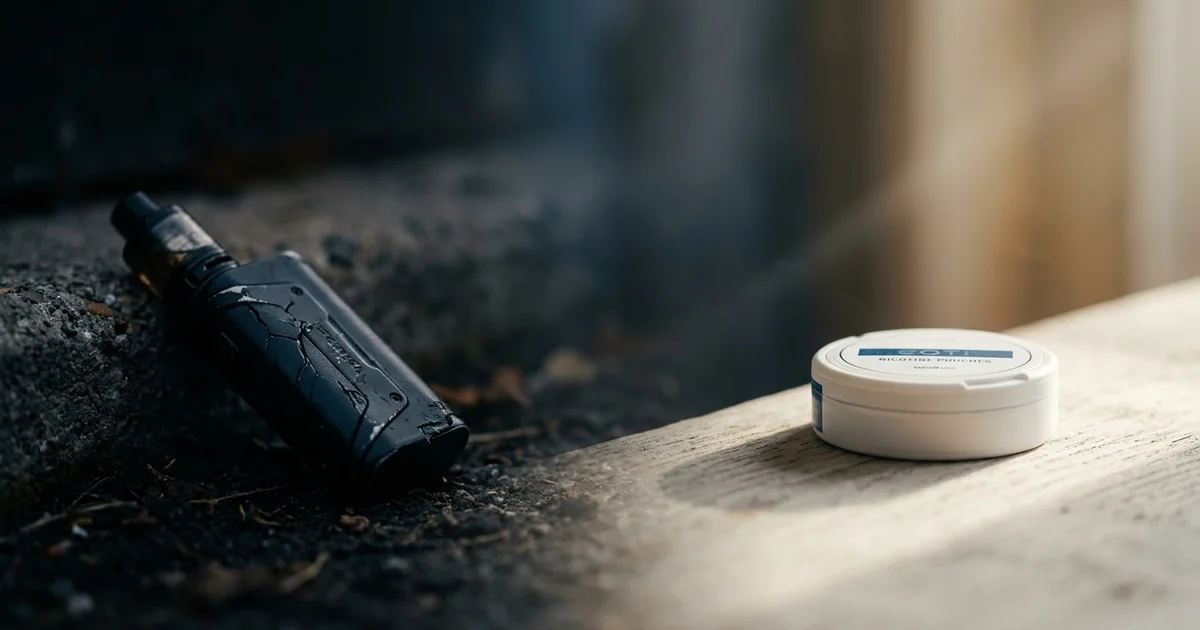
Zyn to Quit Vaping: What You Need to Know
You hit your vape for focus. For stress. For the hand-to-mouth ritual that punctuates your day. Now you want out, and someone told you to try using Zyn to quit vaping. The idea is simple: swap the cloud for a pouch, keep the nicotine, ditch the lung damage. Thousands of people are Googling "zyn to quit vaping" every month looking for exactly this answer.
Here's the problem. You're not quitting nicotine. You're relocating it.
That distinction matters more than most Reddit threads and TikTok testimonials will tell you. This article breaks down what Zyn actually is, whether using Zyn to quit vaping holds up under scrutiny, what the science says about trading one nicotine product for another, and what a genuine off-ramp looks like.
Key Takeaways:
- Zyn delivers pharmaceutical-grade nicotine through your gums, not your lungs. It removes inhalation risk but keeps you dependent on nicotine.
- Zyn is not FDA-approved as a quit-smoking or quit-vaping aid.
- 73% of young people who tried nicotine pouches are still using them, according to the American Lung Association.
- If your goal is to quit nicotine entirely, you need an exit strategy beyond swapping delivery methods.
What Is Zyn, Exactly?
Zyn is a tobacco-free, oral nicotine pouch made by Swedish Match (now owned by Philip Morris International). You tuck it between your upper lip and gum, and nicotine absorbs through the oral mucosa into your bloodstream.
Each pouch comes in either 3mg or 6mg of nicotine, delivered as nicotine salt (nicotine bitartrate dihydrate). The pouches contain no tobacco leaf. They're made with plant-based fibers, stabilizers, pH adjusters, and flavoring. Zyn's official FAQ lists ten flavor varieties in the U.S., from Cool Mint to Coffee.
Compared to a typical vape, Zyn's nicotine delivery is slower. A Juul pod, for reference, packs roughly 40mg of nicotine salt in a single cartridge. A 6mg Zyn pouch delivers its nicotine over 30 to 60 minutes through the gum lining rather than through the lungs. The pharmacokinetics are different: slower onset, longer tail, no inhalation. Understanding this difference is key for anyone considering Zyn to quit vaping.
Can Zyn Help You Quit Vaping?
This is the question everyone is asking, and the honest answer is: sort of, but not really.
Zyn can help you quit vaping specifically because it removes the act of inhaling vapor into your lungs. If your primary concern is respiratory health, switching to an oral nicotine pouch eliminates that variable. No heated chemicals entering your airways. No propylene glycol coating your alveoli.
But are Zyns a good way to quit vaping if your actual goal is to be free of nicotine? No. And this isn't opinion. The Truth Initiative states plainly that oral nicotine pouches like Zyn are not a recommended way to quit nicotine in any form. They also note that nicotine pouches are not the same as FDA-approved nicotine replacement therapies (NRTs) like nicotine gum or lozenges.
The difference? NRTs are designed with tapering protocols. They come in decreasing strengths, and they're paired with behavioral support programs validated by clinical trials. Zyn has no built-in step-down plan. It's a consumer product, not a cessation tool. So while people ask whether Zyn can help quit vaping, the product itself was never designed for that purpose.
The "Harm Reduction" Argument
You'll hear people argue that using Zyn to quit vaping is harm reduction. The logic: nicotine itself isn't the primary carcinogen in cigarettes or the primary lung irritant in vapes. It's the delivery mechanism that causes most of the damage. Remove combustion and inhalation, and you remove most of the acute health risk.
There's some truth here. Most pulmonologists would agree that absorbing nicotine through your gums is less immediately dangerous than pulling aerosolized chemicals into your lungs. But "less harmful" is not the same as "harmless," and it's definitely not the same as "quit."
The American Lung Association warns that nicotine pouches are not FDA-approved quit medications. They also highlight a troubling statistic: 73% of young people who have tried nicotine pouches are currently still using them. That's not a quit rate. That's a retention rate, and it's one any subscription business would envy. For anyone wondering are Zyns a good way to quit vaping, that number should give serious pause.
The Nicotine Trap: Why Swapping Delivery Methods Doesn't Work
Here's what happens in your brain when you use nicotine regularly, regardless of the source.
Nicotine binds to acetylcholine receptors (specifically the nicotinic acetylcholine receptors, or nAChRs) in your brain. This triggers a release of dopamine in the nucleus accumbens, the brain's reward center. That dopamine hit is what makes you feel focused, calm, and alert.
With repeated exposure, your brain upregulates these receptors. It grows more of them, expecting more nicotine. When levels drop, those extra receptors sit empty and screaming for input. That's withdrawal: irritability, brain fog, anxiety, restlessness.
Switching from a vape to a Zyn pouch does nothing to reverse this process. You're still flooding the same receptors. You're still building tolerance. You're still dependent. This is the core problem with using Zyn to quit vaping: you're changing the vehicle, not the destination.
According to Drugs.com, nicotine withdrawal symptoms are typically at their worst during the first week of quitting, especially the first 3 to 5 days. Physical cravings tend to subside within a few weeks, but the mental aspects can persist for months. Every time you reach for a Zyn pouch instead of confronting that withdrawal window, you reset the clock.
What the Data Actually Shows About Nicotine Pouches
The nicotine pouch market is growing fast, and not just among people trying to use Zyn to quit vaping.
Data from the CDC Foundation, released in 2025, shows that nicotine pouch use among youth and young adults has nearly quadrupled between 2022 and 2025. The 2024 National Youth Tobacco Survey found that nicotine pouches were the second most commonly used tobacco product among U.S. youth, behind only e-cigarettes, with 1.8% of middle and high school students reporting current use.
A 2024 study published in PMC found that among high school students, ever-use of nicotine pouches rose from 3.1% in 2023 to 4.7% in 2024. That's a product gaining users, not losing them.
None of this suggests that Zyn is functioning as a bridge to quitting. If anything, the data points to nicotine pouches becoming another lane on the nicotine highway, not an exit ramp. The idea that Zyn can help quit vaping doesn't hold up when the numbers show most users simply stay on nicotine.
Zyn to Quit Vaping vs. FDA-Approved Quit Methods: A Comparison
If you're serious about quitting nicotine, here's how using Zyn to quit vaping stacks up against methods that are actually designed for cessation.
| Method | Nicotine? | FDA-Approved for Cessation? | Step-Down Protocol? | Behavioral Support? |
|---|---|---|---|---|
| Zyn pouches | Yes (3mg or 6mg) | No | No | No |
| Nicotine gum (Nicorette) | Yes (2mg or 4mg) | Yes | Yes | Recommended |
| Nicotine patch | Yes (7mg, 14mg, 21mg) | Yes | Yes (12-week taper) | Recommended |
| Nicotine lozenge | Yes (2mg or 4mg) | Yes | Yes | Recommended |
| Varenicline (Chantix) | No (blocks receptors) | Yes | Built-in | Required |
| Cold turkey | No | N/A | N/A | Recommended |
The difference is clear. FDA-approved NRTs are engineered to wean you off nicotine gradually. Zyn is engineered to deliver nicotine in a satisfying way. Those are fundamentally different goals, and anyone researching Zyn to quit vaping needs to understand that distinction.
The Real Reason You Reach for a Pouch (or a Vape)
Let's be honest about what nicotine actually does for most users. You're not using it because you love the taste of Cool Mint. You're using it because it sharpens your focus for about 20 minutes, takes the edge off stress, and gives you a ritual. Something to do with your hands, your mouth, your break time.
That's the real dependency: not just the chemical, but the behavior. The pocket check for your vape. The familiar motion of tucking a pouch. The micro-reward that breaks up a long afternoon.
This is why asking are Zyns a good way to quit vaping is the wrong question. The right question is: what do you actually need from this habit, and can you get it without nicotine?
If the answer is focus, there are compounds that deliver it without dependency. If the answer is a ritual, you need a replacement that satisfies the behavioral loop without feeding the chemical one. That reframe is what separates people who successfully quit from those who just keep switching products.
Building an Actual Exit Strategy
If you're currently vaping and want to quit, here's a framework that works better than a lateral move to Zyn. Anyone serious about quitting needs more than Zyn to quit vaping; they need a real plan.
1. Set a quit date and taper. If you're using a high-nicotine vape, step down to lower concentrations over 2 to 4 weeks before your quit date.
2. Use FDA-approved NRTs if needed. Nicotine patches or lozenges with a structured taper give you a controlled off-ramp. Talk to your doctor.
3. Address the behavioral triggers. Identify when you reach for nicotine: after meals, during work stress, on breaks. Replace those moments with something that fills the same gap.
4. Get support. The National Cancer Institute notes that withdrawal cravings come and go, and they get farther apart over time. Having a plan for the first 3 to 5 days, when symptoms peak, is the difference between quitting and relapsing.
5. Replace the ritual, not just the chemical. This is the step most people skip. You need something in your pocket, something for your break, something that signals to your brain: this is the thing I do now. This step is what makes the difference between someone who tried Zyn to quit vaping and ended up on Zyn forever, and someone who actually got free.
Same Ritual, Zero Nicotine, Actual Cognitive Benefits
This is where most "quit vaping" articles end with a shrug and a hotline number. But there's a practical gap that deserves filling: what do you do with the pouch-shaped hole in your routine?
Roon was built for exactly this. It's a sublingual pouch, same form factor you're used to, but with zero nicotine. Instead, it contains a stack of caffeine (40mg), L-Theanine, theacrine, and methylliberine, compounds with actual research behind their cognitive effects.
A study published in Nutritional Neuroscience found that the combination of L-theanine and caffeine improved both speed and accuracy on attention-switching tasks while reducing susceptibility to distraction. A second study from the same journal confirmed that moderate levels of L-theanine and caffeine improved accuracy during task switching and increased self-reported alertness.
That's the focus you were chasing with nicotine, delivered through a pouch you already know how to use, without the receptor upregulation, without the withdrawal, and without the dependency cycle that keeps pulling you back.
You don't need Zyn to quit vaping. You need an upgrade to the ritual. Try Roon.
READY TO UNLOCK YOUR FOCUS?
Subscribe for exclusive discounts and more content like this delivered to your inbox.