WHAT ARE NOOTROPIC POUCHES? HOW THEY WORK FOR FOCUS (AND WHICH ONES ARE WORTH IT)
Roon Team
What Are Nootropic Pouches? How They Work for Focus (And Which Ones Are Worth It)
A small pouch between your lip and gum. No nicotine, no tobacco, no liquid to chug. Just a controlled dose of cognitive-supporting compounds absorbed straight into your bloodstream. That's the pitch behind nootropic pouches, and the category is growing fast for a reason: people are tired of the jitter-crash cycle that comes with most stimulants.
But not all nootropic pouches are built the same. The ingredients vary wildly from brand to brand, the dosages range from clinical to cosmetic, and the actual experience can be anything from "barely noticeable" to "locked in for four hours." This guide breaks down exactly how nootropic pouches work, what separates the good ones from the gimmicks, and which products are worth your money in 2025.
Key Takeaways
- Nootropic pouches deliver focus-supporting ingredients through the lining of your mouth, bypassing digestion for faster absorption.
- The ingredients matter more than the format. Some nootropic pouches contain well-studied compounds; others are glorified flavored fiber.
- Duration and crash profile vary by brand, depending on whether the formula addresses caffeine's downsides or just repackages them.
- The best nootropic pouches combine multiple mechanisms of action, pairing stimulants with calming agents and tolerance-resistant compounds.
What Are Nootropic Pouches, Exactly?
So what are nootropic pouches? A nootropic pouch is a small, pre-portioned packet you place between your lip and gum. The active ingredients absorb through your oral mucosa (the tissue lining your cheeks and gums) directly into your bloodstream. This is called buccal absorption, and it's the same delivery method used in certain pharmaceutical applications because it bypasses first-pass metabolism in the liver, improving bioavailability compared to swallowing a capsule.
Think of it as the difference between drinking a cup of coffee and holding the active compounds against the most absorbent tissue in your mouth. The onset is faster. The dose is more predictable. And you skip the GI issues that come with ingesting stimulants on an empty stomach.
Most nootropic pouches on the market are nicotine-free and tobacco-free. They're designed for people who want cognitive support without dependency, and they've become popular as alternatives to nicotine pouches like Zyn among people looking to quit or avoid nicotine entirely.
How Do Nootropic Pouches Work?
Understanding how do nootropic pouches work starts with the delivery mechanism. You place the pouch in your mouth, and the active ingredients dissolve and pass through the thin mucosal membrane into your capillaries. From there, they enter systemic circulation within minutes.
What happens next depends entirely on the ingredients inside. Here's how nootropic pouches work across three distinct layers.
The Stimulant Layer
Most nootropic pouches contain some form of stimulant, usually caffeine or a caffeine-adjacent compound like paraxanthine or guarana. This is the part that wakes you up. Caffeine works by blocking adenosine receptors in your brain, which are the receptors responsible for making you feel sleepy. The result: increased alertness and faster reaction times.
The problem with caffeine alone is well-documented. It spikes cortisol, narrows your focus window, and wears off with a crash. It also builds tolerance quickly, meaning you need more over time to get the same effect.
The Calming Layer
Better nootropic pouches pair their stimulant with something that smooths out the rough edges. L-Theanine is the most common choice here, and for good reason. A study published on PubMed found that 97mg of L-Theanine combined with 40mg of caffeine improved focused attention during demanding cognitive tasks. L-Theanine promotes alpha brain wave activity, which is associated with a state of calm alertness. It takes the edge off caffeine without dulling the focus.
A 2025 study in the British Journal of Nutrition reinforced this, showing that the L-Theanine and caffeine combination improved selective attention even in sleep-deprived subjects.
The Duration Layer
This is where most nootropic pouches fall short. Caffeine has a half-life of about five hours, but the subjective "focus window" is much shorter, typically 60 to 90 minutes before the jitters set in or the effect fades. Compounds like theacrine and methylliberine extend that window.
Theacrine is structurally similar to caffeine but acts on the same receptors with a longer half-life and less habituation. That last part is the key: your body doesn't build tolerance to theacrine the way it does to caffeine. A study covered by NutraIngredients found that theacrine at 200mg provided consistent improvements in energy, focus, and mood without the habituation effect seen with caffeine.
Methylliberine works on a faster timeline. Research published in the journal Nutrients found that methylliberine improved subjective feelings of energy, concentration, and motivation, with effects sustaining longer than placebo. When combined with caffeine and theacrine, research covered by NutraIngredients found the trio improved speed, accuracy, and cognitive performance compared to caffeine alone.
Nootropic Pouches Compared: What's Actually in Them
Here's where it gets interesting. The category is young, and the formulas vary dramatically. Let's look at the major nootropic pouches side by side.
| Brand | Key Ingredients | Caffeine | Duration (Claimed) | Price Range | Pouches/Can |
|---|---|---|---|---|---|
| Alpha (Fully Loaded) | Alpha GPC (50mg), L-Tyrosine (50mg), Taurine (20mg), Guarana (20mg), Theobromine (15mg) | 50mg | Not specified | ~$5–7/can | 15 |
| Nectr | Cognizin® Citicoline (62.5mg), Natural Caffeine | 30mg | Not specified | ~$7–9/can | 16 |
| Ultra | Enfinity® Paraxanthine, Vitamins | 0mg (uses paraxanthine) | 1–2 hours | ~$5–7/can | 15 |
| Cyclone Pods | Ashwagandha, Lion's Mane, Cordyceps, Bacopa Monnieri, Guarana | Varies (via guarana) | Not specified | ~$6–8/can | 20 |
| Roon | Caffeine (40mg), L-Theanine, Theacrine, Methylliberine | 40mg | 4-6 hours | See website | Varies |
Alpha (Fully Loaded)
Alpha comes from Fully Loaded, a company with roots in the chewing tobacco alternative space. Their Fuel pouches pack 50mg of caffeine alongside Alpha GPC and L-Tyrosine. Alpha GPC supports acetylcholine production (your brain's primary learning neurotransmitter), and L-Tyrosine is a precursor to dopamine.
The formula is stimulant-forward. With 50mg of caffeine plus 20mg of guarana (which contains more caffeine), you're looking at a decent energy hit. But there's no calming agent to offset the stimulant load, and no tolerance-resistant compounds. The effect profile is likely sharp but short.
Nectr
Nectr uses Cognizin® Citicoline as its flagship ingredient, a patented form of citicoline with clinical research behind it. Citicoline supports phospholipid synthesis in brain cell membranes and has been studied for its effects on attention and memory. The caffeine dose is modest at 30mg.
The weak spot: there's no mechanism to extend the focus window or prevent tolerance. Citicoline is a solid long-term brain health compound, but for acute, in-the-moment focus, these nootropic pouches may not deliver the same punch as a multi-compound stack.
Ultra
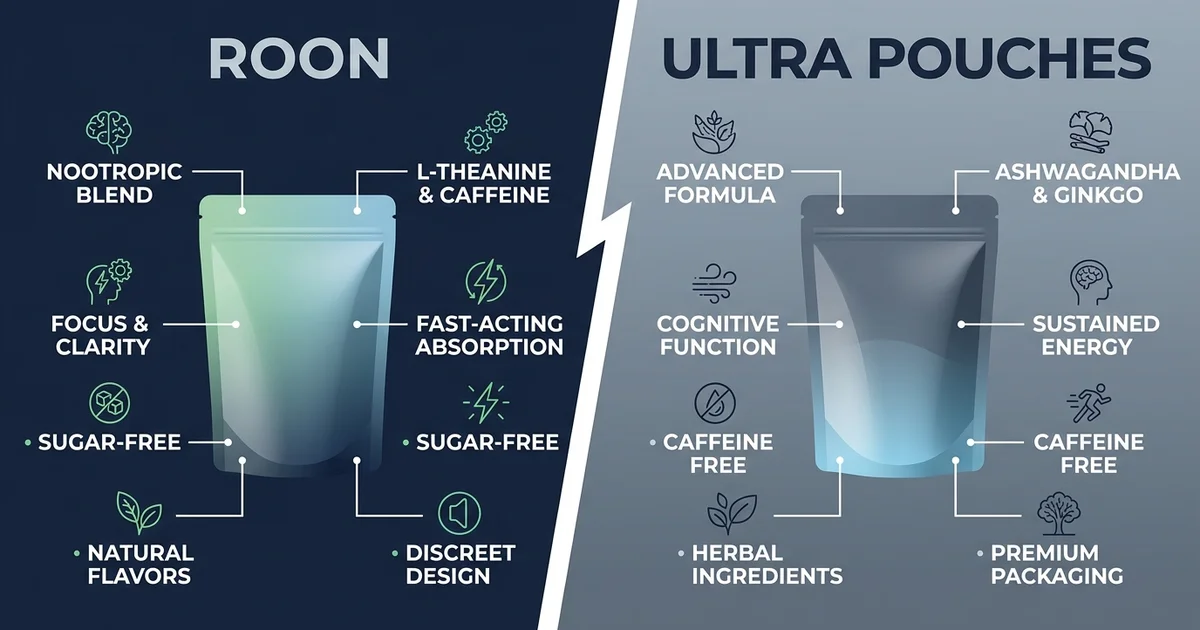
Ultra took a different approach by ditching caffeine entirely in favor of Enfinity® paraxanthine, a primary metabolite of caffeine. Paraxanthine delivers similar alertness without some of caffeine's cardiovascular side effects. They also include vitamins and other nootropic compounds.
The trade-off is duration. Ultra claims effects lasting 1 to 2 hours, which is on the short end for anyone needing sustained focus through a full work session or study block.
Cyclone Pods
Cyclone Pods goes wide with their ingredient list: ashwagandha, Lion's Mane, Cordyceps, Bacopa Monnieri, and guarana. It reads like a who's who of adaptogenic and nootropic ingredients. Each has individual research supporting various cognitive benefits.
The concern here is dosing. When you pack six or seven ingredients into a single pouch, the dose of each individual compound is often too low to match the amounts used in clinical studies. Adaptogenic herbs like ashwagandha typically need 300mg or more to show effects. A pouch can only hold so much material.
What's Missing Across the Nootropic Pouches Category
After looking at the field, a few consistent gaps emerge among today's nootropic pouches.
1. No product combines all three layers effectively. Most nootropic pouches nail one or two aspects of cognitive support but miss the third. Alpha and Nectr deliver stimulation without a calming counterbalance. Ultra addresses the jitter problem but sacrifices duration. Cyclone Pods spreads its formula across too many ingredients to hit effective doses on any single one.
2. Tolerance is the elephant in the room. Caffeine tolerance builds within days of consistent use. If your nootropic pouches rely on caffeine as their only active stimulant, the effect will diminish over time. Only one compound in this space, theacrine, has demonstrated resistance to habituation in research. Most brands don't include it.
3. Duration is consistently short. The 1 to 2 hour effect window that most brands claim (or that users report) doesn't cover a real work session. If you need to stay focused through a three-hour deep work block or a long study session, you're either re-dosing frequently or accepting diminished returns in the back half.
4. The calming-stimulant balance is usually off. Nootropic pouches that include caffeine rarely pair it with L-Theanine or a similar compound at the ratios shown to work in clinical research. You get the alertness, but you also get the narrowed focus, the restlessness, and the crash.
How Roon's Nootropic Pouches Address These Gaps
Roon was built around the specific problem that most nootropic pouches only solve half the equation. Its formula pairs 40mg of caffeine with L-Theanine (for the calming layer), theacrine (for tolerance resistance and extended duration), and methylliberine (for rapid-onset energy and mood support).
Here's what that means in practice:
- The caffeine and L-Theanine pairing mirrors the ratio studied in clinical research for focused attention without jitters.
- Theacrine extends the effective window to 4 to 6 hours and resists the tolerance buildup that makes caffeine-only products less effective over time.
- Methylliberine provides the initial lift, bridging the gap between placing the pouch and feeling the full effects of the slower-acting compounds.
The result is a focus curve that rises smoothly, holds steady, and tapers off without a crash. Roon's nootropic pouches aren't a replacement for sleep, proper nutrition, or exercise. But for the specific problem of sustained, clean cognitive performance in a convenient format, the four-compound stack addresses the gaps that simpler formulas leave open.
If you're exploring nootropic pouches for the first time, or if you've tried one of the products above and found the effect too short or too jittery, Roon is worth a look.
READY TO UNLOCK YOUR FOCUS?
Subscribe for exclusive discounts and more content like this delivered to your inbox.