ROON VS THESIS NOOTROPICS: PERSONALIZED BLENDS OR ONE CLEAN POUCH?
Roon Team
Roon vs Thesis Nootropics: Personalized Blends or One Clean Pouch?
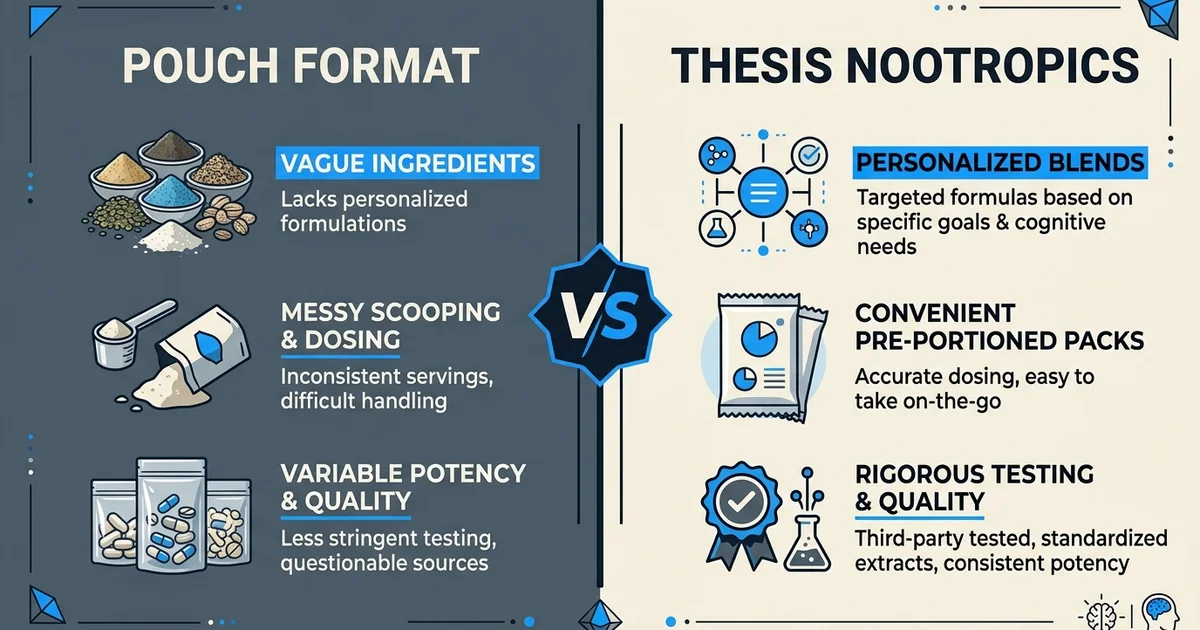
The roon vs thesis debate starts with a simple question: how do you want your brain to perform when it matters? This comparison comes down to philosophy. Thesis sells you a personalized system of rotating capsule blends. Roon sells you a single sublingual pouch with four targeted compounds. Same goal, radically different execution.
Both products sit in the premium tier of the nootropic market. Both claim to support focus, energy, and mental clarity without the downsides of traditional stimulants. But the similarities end there.
This is the best nootropic comparison you'll find between these two, because we're going beyond marketing copy and into what actually matters: ingredients, delivery, cost, and what each product asks of you as a user.
Key Takeaways:
- Thesis offers six different capsule blends (Energy, Clarity, Logic, Creativity, Motivation, Confidence), each with unique ingredient profiles
- Roon delivers a single formula (Caffeine, L-Theanine, Theacrine, Methylliberine) through a sublingual pouch
- Thesis costs $79/month on subscription or ~$120+ for a starter kit
- The roon vs thesis divide comes down to complexity, delivery method, and daily commitment
How Thesis Nootropics Works
Thesis takes a quiz-based, personalized approach. You fill out an online questionnaire about your goals, lifestyle, and sensitivities. Based on your answers, Thesis recommends a starter kit containing four of their six blends. You try each one for a week, identify which works best for you, then subscribe to your favorites.
The six blends are Energy, Clarity, Creativity, Logic, Motivation, and Confidence. Each formula is built with unique ingredients to serve a specific purpose.
Here's what you'll find across the Thesis lineup:
- Energy: N-Acetyl-L-Tyrosine, Choline, Caffeine, L-Theanine
- Clarity: Lion's Mane, Alpha GPC, Caffeine, L-Theanine
- Logic: Bacopa Monnieri, Ginkgo Biloba, Caffeine, L-Theanine
- Confidence: Ashwagandha (Shoden), Saffron Extract, Caffeine, L-Theanine
- Motivation: Artichoke Extract, Vitamin B12, Methylliberine, L-Theanine
- Creativity: Features ingredients like Alpha GPC and Panax Ginseng
According to multiple reviews, every blend contains Caffeine and L-Theanine, which means the base stimulant effect is consistent across the range. The differentiating ingredients (Lion's Mane, Bacopa, Ashwagandha, etc.) are what change from blend to blend. Understanding this shared base is essential to any roon vs thesis evaluation.
The format is standard capsules. You take them in the morning, ideally on an empty stomach. According to Thesis, effects can be felt in as little as 30 minutes depending on your genetics and experience with nootropics.
How Roon Works
Roon takes the opposite approach. Instead of six blends and a quiz, you get one formula in a sublingual pouch. Place it between your gum and lip. The active ingredients absorb directly through the oral mucosa, bypassing the digestive system entirely.
The formula contains four compounds:
- Caffeine (40mg): A deliberately low dose, roughly equivalent to half a cup of coffee
- L-Theanine: The amino acid found in tea that promotes calm focus
- Theacrine: A purine alkaloid structurally similar to caffeine but with a longer duration and reduced tolerance buildup
- Methylliberine: A fast-acting purine alkaloid that complements Theacrine's slower onset
No quiz. No rotating blends. No capsules to swallow with water. One pouch, one stack, consistent results. That simplicity is what makes the roon vs thesis decision so clear for many users.
Roon vs Thesis Nootropics: The Head-to-Head Comparison
Here's how these two products stack up across the categories that actually matter in this best nootropic comparison:
| Category | Thesis | Roon |
|---|---|---|
| Format | Capsules (oral) | Sublingual pouch |
| Blends/Formulas | 6 different blends | 1 formula |
| Caffeine Content | Present in most blends (dose varies) | 40mg per pouch |
| Key Differentiating Ingredients | Lion's Mane, Bacopa, Ashwagandha, Alpha GPC, Ginkgo | Theacrine, Methylliberine |
| Delivery Speed | ~30 minutes (oral digestion) | Faster (sublingual absorption) |
| Monthly Cost | ~$79/month (subscription) | See takeroon.com for current pricing |
| Personalization | Quiz-based blend selection | Single optimized stack |
| Nicotine | N/A (capsule format) | Zero nicotine |
| Requires Water | Yes | No |
Ingredients: Breadth vs Depth
The roon vs thesis ingredients story is one of breadth versus depth. Thesis wins on ingredient diversity. Across their six blends, they cover adaptogens (Ashwagandha), mushroom extracts (Lion's Mane), herbal nootropics (Bacopa, Ginkgo), and cholinergics (Alpha GPC). If you're interested in exploring how different nootropic compounds affect you personally, Thesis gives you a structured way to do that.
Roon wins on ingredient specificity. The four compounds in the Roon pouch were selected to work as a single, self-reinforcing stack. A study published on PubMed found that 97mg of L-Theanine combined with 40mg of caffeine helped focus attention during demanding cognitive tasks. That's the exact caffeine dose Roon uses.
Theacrine and Methylliberine add a dimension that Thesis mostly lacks (though Thesis does include Methylliberine in their Motivation blend). A 2025 study in the Journal of the International Society of Sports Nutrition confirmed that Theacrine is safe at doses up to 300 mg/day for eight weeks, supporting consistent energy and focus without tolerance development. And Methylliberine acts as a fast-onset complement. According to Nootropics Depot, Methylliberine is faster acting than Theacrine, with a more immediate impact on energy, mood, and focus.
Together, these four compounds create a layered effect. Caffeine and Methylliberine kick in quickly. L-Theanine smooths out the stimulant edge. Theacrine extends the duration without the tolerance curve that caffeine alone produces. This layered design is a key differentiator in the roon vs thesis nootropics matchup.
Delivery: Capsules vs Sublingual
This is a bigger difference than most roon vs thesis articles acknowledge.
Thesis uses standard capsules. That means the ingredients pass through your stomach and liver before reaching your bloodstream (first-pass metabolism). It works, but it's slower, and bioavailability varies based on what you've eaten, your gut health, and individual metabolism.
Roon's sublingual delivery skips that entire process. The mucous membranes under your lip absorb the active compounds directly into the bloodstream. It's the same principle behind sublingual medications that doctors prescribe when they need faster, more reliable absorption.
You also don't need water, a meal plan, or a morning routine built around capsule timing. You just place the pouch and go. For anyone weighing roon vs thesis, delivery method alone can be the deciding factor.
Cost and Complexity
According to Hone Health's review, Thesis costs $79 a month on subscription, or about $3.29 per serving. The starter kit runs higher, around $120 or more. And that's for one blend at a time. If you want to rotate between two or three blends (which Thesis encourages), the monthly cost climbs.
As SOMA Analytics noted in their review, that price point is roughly twice what you'd pay for some competing nootropic products. Cost is a real consideration in any roon vs thesis decision.
Beyond price, there's the complexity tax. Thesis requires you to take a quiz, try four blends over four weeks, track your responses, decide which works best, manage a subscription with potential blend swaps, and potentially consult with their coaching team. That process can be valuable. It can also be exhausting if you just want something that works today.
What's Missing from Both Products
No product is perfect. A thorough best nootropic comparison requires honesty about where each falls short.
Where Thesis falls short:
- Capsule-only delivery limits absorption speed and bioavailability. You're at the mercy of your digestive system.
- Complexity as a feature isn't for everyone. The quiz, the rotation, the tracking period. Some people want a solution, not a science experiment.
- Caffeine in every blend means you can't truly escape stimulant dependence within their system. And since caffeine tolerance builds quickly, the base effect of every Thesis blend will diminish over weeks of daily use without cycling.
- No tolerance-mitigation strategy. Thesis doesn't include Theacrine or similar compounds (except Methylliberine in one blend) that address the tolerance problem directly.
Where Roon falls short:
- No ingredient variety. If you want adaptogens like Ashwagandha, mushroom extracts like Lion's Mane, or cholinergics like Alpha GPC, Roon doesn't offer them. It's a focused stack, not a broad-spectrum nootropic.
- No personalization. Everyone gets the same formula. If you're someone who responds poorly to caffeine (even at 40mg), there's no caffeine-free option.
- Single use case. Roon is built for focus and sustained energy. It's not designed for sleep, relaxation, or mood support the way some Thesis blends aim to be.
The shared gap:
Neither product addresses long-term cognitive health ingredients like Omega-3s, Phosphatidylserine, or Vitamin D. Both are performance tools, not neuroprotective stacks. That's fine, but worth knowing as you evaluate roon vs thesis for your own needs.
Why Roon's Simplicity Might Be the Point
The best nootropic comparison isn't just about ingredients on a label. It's about what you'll actually use consistently. That's where the roon vs thesis conversation gets practical.
Thesis is built for the nootropic enthusiast: someone who enjoys the process of testing, tracking, and optimizing. If that's you, Thesis offers a structured and reasonably well-formulated system for exploring different cognitive targets.
But most people searching for a focus tool aren't looking for a four-week onboarding process. They're looking for something that works in minutes, fits in a pocket, and delivers the same result every time they use it. That's why roon vs thesis often tips toward Roon for people who value speed and consistency.
That's the problem Roon was designed to solve. Four compounds that work together: Caffeine at a controlled 40mg dose, L-Theanine to keep it smooth, Theacrine for duration without tolerance, and Methylliberine for fast onset. Delivered sublingually so it absorbs in minutes, not the better part of an hour.
No quiz. No rotating blends. No capsules. No water needed. Just a pouch that does one thing well: 4-6 hours of sustained, jitter-free focus.
Roon won't give you Ashwagandha's stress support or Lion's Mane's long-term neural benefits. But if what you need is reliable cognitive performance on demand, without the complexity of managing a multi-blend subscription system, the roon vs thesis choice becomes straightforward. Roon is worth a serious look.
Try it at takeroon.com.
READY TO UNLOCK YOUR FOCUS?
Subscribe for exclusive discounts and more content like this delivered to your inbox.