NATURAL SUPPLEMENTS FOR ANXIETY: WHAT ACTUALLY WORKS (AND WHAT'S JUST MARKETING)
Roon Team
Natural Supplements for Anxiety: What Actually Works (and What's Just Marketing)
About 42.5 million American adults live with an anxiety disorder right now. That makes natural supplements for anxiety one of the most searched-for topics in health, and for good reason: anxiety is the single most common mental health condition in the country, according to recent prevalence data. And the numbers keep climbing: a 2024 poll from the American Psychiatric Association found that 43% of adults felt more anxious than the year before, up from 37% in 2023.
So it makes sense that the market for natural supplements for anxiety has exploded. The problem? Most of what you'll find on a supplement shelf is backed by thin evidence, aggressive marketing, or both.
This article breaks down the anxiety herbal supplements and compounds that actually have clinical data behind them, the ones that don't, and how to tell the difference.
Key Takeaways
- L-theanine has strong evidence for promoting calm without sedation, largely through its effects on alpha brain waves and GABA activity.
- Ashwagandha can measurably lower cortisol levels, with multiple placebo-controlled trials supporting its use for stress and anxious feelings.
- Magnesium and omega-3 fatty acids show real promise as natural supplements for anxiety, but dosage and form matter more than most brands will tell you.
- Valerian root and passionflower have a long folk history but weaker clinical backing than you'd expect.
- No supplement replaces professional treatment for diagnosed anxiety disorders.
How Natural Supplements for Anxiety Actually Work in the Brain
Anxiety isn't one thing. It's a cascade of overlapping neurochemical events: excess cortisol, low GABA tone, overactive amygdala signaling, disrupted serotonin pathways. Different natural supplements for anxiety target different parts of this cascade, which is why some work for certain people and not others.
The compounds worth your attention generally do one or more of the following:
- Increase GABA activity, which quiets excitatory neural firing
- Reduce cortisol, the primary stress hormone
- Promote alpha brain wave production, the electrical pattern associated with relaxed alertness
- Modulate serotonin or dopamine, affecting mood regulation
That's the framework for evaluating any natural anxiety supplements you encounter. Now let's look at the evidence for each major compound.
L-Theanine: The Best-Studied Natural Supplement for Anxiety
L-theanine is an amino acid found naturally in tea leaves. It crosses the blood-brain barrier within about 30 minutes of ingestion, and its primary effect is increasing alpha wave activity in the brain. Alpha waves are the electrical signature of a calm but alert mind, the state you're in during focused meditation or a flow state.
A 2024 review published in the journal Nutrition Reviews (via ScienceDirect) confirmed that L-theanine at standard supplement dosages (50 to 250mg) increases alpha waves in healthy people and promotes psychophysical relaxation without causing drowsiness.
The mechanism is well-mapped. L-theanine influences GABA, the brain's main inhibitory neurotransmitter. A 2025 study in the Journal of Anaesthesiology Clinical Pharmacology found that both L-theanine and GABA produced effective anxiolysis (anxiety reduction) with minimal sedation and even improvements in cognitive performance. That's a rare combination among natural supplements for anxiety. Most things that calm you down also slow you down.
A randomized, placebo-controlled crossover study published in Nutrients (via PMC) also demonstrated that a single dose of L-theanine reduced stress responses in healthy adults under acute stress conditions.
The bottom line: L-theanine is one of the few natural anxiety supplements with consistent, replicable evidence across multiple trial designs. The effective dose in most studies falls between 100mg and 200mg.
Ashwagandha: The Cortisol Reducer
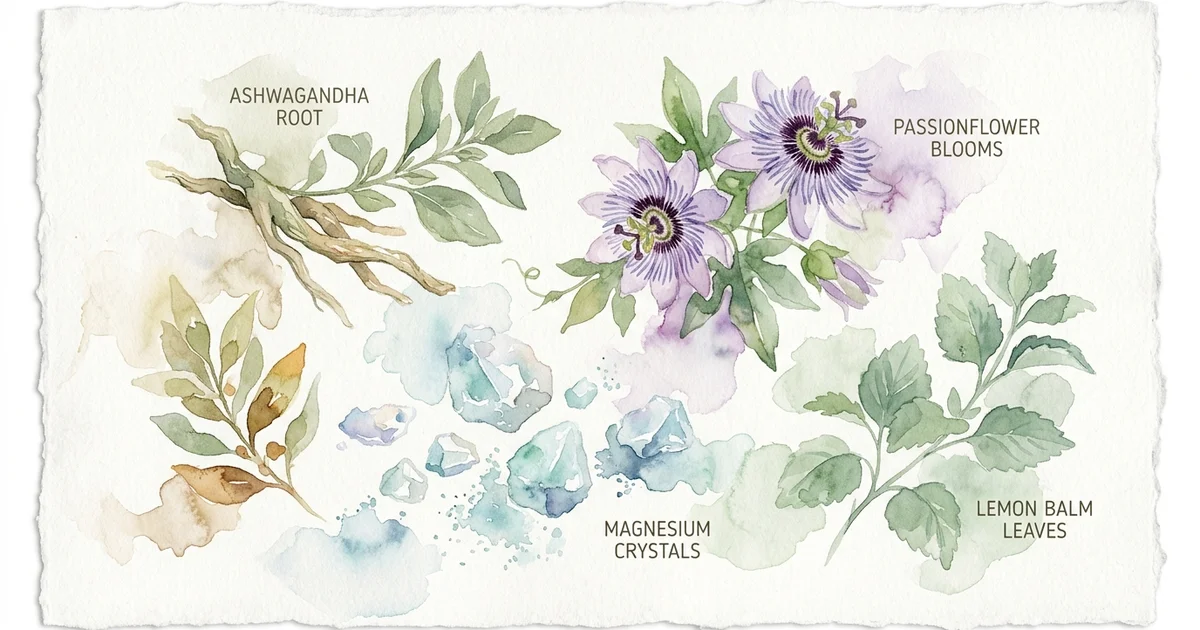
Ashwagandha (Withania somnifera) is an adaptogenic herb with a long history in Ayurvedic medicine. But unlike many traditional remedies, it has a growing body of modern clinical evidence, making it one of the more credible anti anxiety herbal supplements available.
A 2024 systematic review and meta-analysis published in BJPsych Open analyzed multiple randomized controlled trials and found that ashwagandha supplementation produced statistically significant reductions in cortisol levels, Perceived Stress Scale (PSS) scores, and Hamilton Anxiety Rating Scale (HAM-A) scores compared to placebo.
The cortisol angle is particularly interesting for anyone researching natural supplements for anxiety. A randomized, double-blind trial published in Medicine showed that ashwagandha intake was associated with greater reductions in morning cortisol compared to placebo. Since chronically elevated cortisol is one of the primary biological drivers of persistent anxious feelings, lowering it has downstream effects on sleep, mood, and cognitive clarity.
Another double-blind, placebo-controlled study (via PMC) reported that by day 60 of ashwagandha use, participants saw a 75.6% reduction in scores on the anxiety item subset of their assessment tool.
What to Look For
Not all ashwagandha extracts are the same. Studies showing the strongest effects typically use root extracts standardized to withanolide content (usually 2.5% to 5%). A 2023 trial published in PubMed specifically found that ashwagandha root extract with 2.5% withanolides improved stress and anxiety by reducing cortisol and increasing serotonin in healthy adults.
Dose ranges in positive trials generally fall between 300mg and 600mg per day.
Omega-3 Fatty Acids: Underrated for Anxious Feelings
Most people associate omega-3s with heart health. But the brain is roughly 60% fat, and omega-3 fatty acids (particularly EPA and DHA) play a direct role in neuronal membrane fluidity, inflammation regulation, and neurotransmitter function. That makes them an often-overlooked category of natural supplements for anxiety.
A 2024 dose-response meta-analysis in BMC Psychiatry analyzed 23 trials with 2,189 participants and found that each 1 gram per day of omega-3 supplementation resulted in a moderate decrease in anxiety symptoms.
An earlier meta-analysis in JAMA Network Open, which reviewed 19 clinical trials across 2,240 participants from 11 countries, also found that omega-3 treatment was associated with reduced anxiety symptoms compared to placebo, in both placebo-controlled and non-placebo-controlled groups.
The key detail: EPA appears to be the more important fatty acid for mood and anxiety, not DHA. Look for supplements where EPA makes up at least 60% of the total omega-3 content, and aim for a combined dose of at least 1 gram per day.
Magnesium: The Baseline You're Probably Missing
Magnesium is involved in over 300 enzymatic reactions in the body, including several that directly regulate the HPA axis (your stress response system) and GABA receptor function. Subclinical magnesium deficiency is common in Western diets, and there's growing evidence that this deficiency alone can contribute to heightened anxiety.
The form matters. Magnesium glycinate and magnesium threonate are the most bioavailable forms for brain-related effects. Magnesium oxide, the cheapest form you'll find in most drugstore supplements, has poor absorption and is unlikely to move the needle on anxiety.
If you're exploring natural supplements for anxiety, magnesium is a reasonable starting point simply because so many people are deficient. It won't produce the acute calming effect of L-theanine, but correcting a deficiency can lower your baseline stress reactivity over weeks.
Valerian Root and Passionflower: Traditional, but Limited Evidence
Valerian root and passionflower are two of the most commonly marketed anxiety herbal supplements. They have centuries of traditional use and some preliminary clinical data. But the evidence is thinner than you might expect from such popular anti anxiety herbal supplements.
Valerian root appears to increase GABA availability in the brain. According to Talkspace's clinical review, higher GABA levels from valerian have been associated with reduced anxiety symptoms. But most valerian studies are small, short, and inconsistent in their dosing protocols.
Passionflower has slightly more interesting data. A clinical reference from PeaceHealth notes that in one study, 45 drops per day of passionflower extract taken for four weeks was as effective as 30mg per day of oxazepam, a benzodiazepine used for anxiety. That's a striking finding, but it's a single study, and it hasn't been replicated at scale.
Both herbs are generally safe and may help with mild anxious feelings or sleep disruption. But if you're looking for natural supplements for anxiety with the strongest evidence base, L-theanine and ashwagandha are ahead by a wide margin.
Natural Supplements for Anxiety: A Quick Comparison
| Supplement | Primary Mechanism | Evidence Strength | Typical Dose | Onset |
|---|---|---|---|---|
| L-Theanine | Alpha waves, GABA modulation | Strong (multiple RCTs) | 100-200mg | 30-60 min |
| Ashwagandha | Cortisol reduction, serotonin | Strong (meta-analyses) | 300-600mg/day | 2-4 weeks |
| Omega-3 (EPA) | Anti-inflammatory, membrane function | Moderate-Strong | 1g+/day | 4-8 weeks |
| Magnesium | GABA receptor, HPA axis | Moderate | 200-400mg/day | 2-4 weeks |
| Passionflower | GABAergic | Limited | Varies | 30-60 min |
| Valerian Root | GABA availability | Limited | 300-600mg | 30-60 min |
What to Actually Do With This Information
Start with the basics. If you're not sleeping well, eating enough omega-3s, or getting adequate magnesium, fix those first. No natural supplement for anxiety can compensate for a broken foundation.
If you want targeted support for anxious feelings, L-theanine has the best risk-to-reward ratio among natural supplements for anxiety. It works fast, it doesn't sedate you, and the side effect profile is essentially nonexistent. Ashwagandha is a strong second choice for longer-term cortisol management.
And if you're dealing with clinical anxiety, talk to a professional. Natural anxiety supplements can support your mental health, but they're not a substitute for therapy or prescribed medication when those are warranted.
Calm Focus Without the Fog
Here's the thing about most natural supplements for anxiety: they trade sharpness for calm. You feel less anxious, but you also feel less... everything. That's the sedation tradeoff, and it's the reason so many people abandon natural anxiety supplements after a few weeks.
L-theanine is the exception. It promotes GABA activity and alpha wave production without dimming your cognitive edge. That's exactly why it's one of the core ingredients in Roon, a sublingual performance pouch that pairs L-theanine with caffeine, theacrine, and methylliberine. The combination supports sustained, calm focus for 4 to 6 hours with no jitters, no crash, and no tolerance buildup.
A 2022 study published in Cureus (via PMC) found that the combination of caffeine, theacrine, and methylliberine increased cognitive performance and reaction time without interfering with mood.
Calm focus, not drowsy calm. That's the difference.
If you're looking for natural supplements for anxiety that keep you sharp and steady through your day without the sedation that most options bring, check out Roon.
READY TO UNLOCK YOUR FOCUS?
Subscribe for exclusive discounts and more content like this delivered to your inbox.